

Sovereign Spanish Magistral Order of the Knights Templar
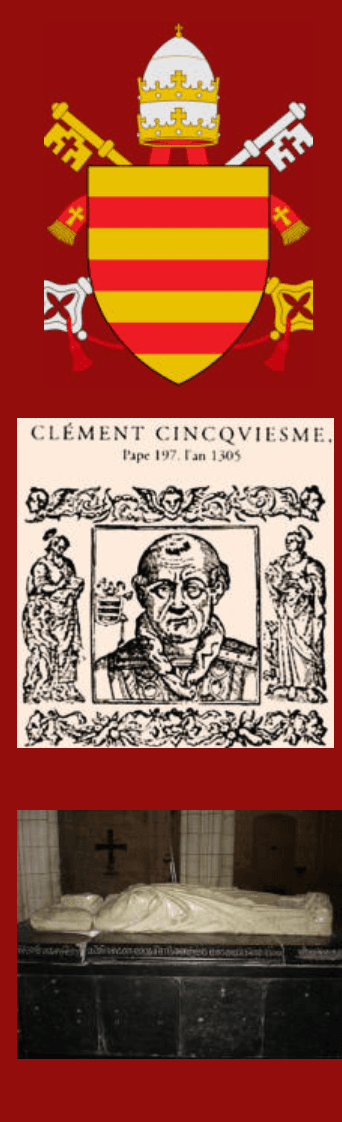
Clemente V
Clement V, (Villandraut, 1264 – Roquemaure, April 20, 1314). Pope No. 195 of the Catholic Church from 1305 to 1314 and first pontiff who lived stably in Avignon Born Bertrand de Got, was educated in the priory of Defés in the diocese of Agen, belonging to the Order of Grandmont.
He studied canon and civil law at the universities of Orleans and Bologna, where he apparently obtained the title of "Magiste After completing his studies was appointed canon in Bordeaux, vicar general in Lyon, chaplain of Pope Boniface VIII, bishop of Comminges and, in 1299, Archbishop of Bordeaux.
Election Main article: Conclave of 1304-05 On the death of Benedict XI, Bertrand de Got was elected pope on 5 June 1305, at the conclave held in Perugia, after eleven months of disputes between opposing cardinals and supporters of the policy of his predecessor, Boniface VIII.
The Archbishop of Bordeaux seems to have been the convenient decision at the time, because he did not belong to the College of Cardinals and therefore was not part of any of the parties in conflict. Moreover, although French was a subject of the King of England and had a neutral position in the conflict between Boniface VIII and King Philip IV of France.
The new pontiff took the name of Clement V.2 Called for his coronation, since being not a cardinal was not present in the conclave, he did not move to Italy but chose the city of Lyon for the ceremony, which took place on November 14, 1305, in the church of Saint-Just, with the assistance of King Philip IV of France.
Lyon was a city of empire but to the liking of the French.3 Clement was throughout his pontificate subject to the wishes of Philip IV,4 and as soon as he was crowned, his first act was the appointment of nine French cardinals close to the French monarch. So turned into a mere tool in the hands of Philip, he annulled in 1306 the ecclesiastical sentences that he considered contrary to his interests, especially the bulls "Lay Clerics" and "Unam Sanctam" (for the French territory) that had promulgated Boniface VIII.5
The most important aspects of his pontificate were: resolving the case of Boniface VIII, the elimination of the Order of the Temple and the transfer of the pontifical headquarters to Avignon.

The case of Boniface VIII Philip the beautiful insisted on his purpose of revenge against Boniface VIII, to the point of not even caring that he was already dead; he wanted an official condemnation of this as heretical.
On the other hand, the party of the so-called Bonifacians insisted on the condemnation of those who participated in the attack of Anagni and the king was complicit in this event. Clement V with a bull declared the king innocent, for, according to him, all that he had done had been animated by a good, sincere and just zeal that proceeded from his fervor for the Catholic faith6
He also lifted the excommunication of William of Nogaret, Sciarra Colonna and the inhabitants of the city who participated in the attack of Anagni; but he did not condemn Boniface VIII, as was the claim of the king. The case was definitively closed in 1312.7 but to calm the spirits of the king of France sacrificed others who were among the objectives of this: the Templars.
Suppression of the Templars See also: Vox in excelse The Order of the Temple had been founded in 1119 in Jerusalem by Hugo de Payens, with the ideal of defending the Holy Land. They had a good administrative organization and therefore came to possess numerous assets and to be one of the richest institutions in medieval Europe. They managed their assets more or less like a modern bank.
By the time of Philip IV, the Templars administered the treasure of the king of France, so up to that time they had been highly esteemed by the crown. The reasons why Philip the Beautiful lashed out strongly against the Templars are not very clear; some assume that he had been indebted to them and could not pay the debt, others that it was for the fidelity of the Order of the Temple to the pope, or for the numerous riches they possessed and that could enlarge the royal treasure.
The truth is that on October 13, 1307 Philip ordered the arrest of all the Templars who were on French territory accusing them of heresy. The reasons given were a series of accusations by a former member of the Order, Esquieu de Floyran (1305), who claimed that the Templars worshipped an idol of Bafomet, reneged on Christ and committed sodomy, among other scandalous things.
Those arrested totaled about two thousand Templars, including the Master General of the Order, Jacques de Molay.8 The arrest of the Templars without the authorization of the pontiff, on whom the Order directly depended, provoked the protests of Clemente, but Philip convinced him to present the confessions obtained under torture.
- He thus succeeded in getting the Pope to enact the bull Pastoralis praeminens, which decreed the detention of the Templars in all Christian territories. Not content, Philip obtained from the Pope a general instruction condemning those who retracted their confessions to the stake. Thus on 12 May 1310, in Paris, 54 Templars were burned. Others died from torture or in prison.
- Pressed by the French king, Clemente convened in 1308, by publishing the bull Regnums in coelis the Council of Vienne. Held between October 1311 and May 1312, the bull Vox will illuminate in excelsed that suppressed the Templar order: We also observe that in other cases the Roman church has suppressed other orders for reason of much less gravity than those mentioned above, without recriminating those who did this for their brothers.
- Thus, with the sad heart, not by the definitive declaration but if by the Apostolic decision or ordinance, we suppress, with the approval of the sacred council, the Order of the Templars, and its rule, habit and name, by inviolable and perpetual decree, and completely forbid that someone henceforth enters into the order, either receives or wears his habit, or behaves like a Templar. If someone acts that way, whether open as secretly, they will incur automatic excommunication.
- Clement V, Vox in excelsus The Pontifical See in Avignon In 1309 Clement V moved the papal see of Rome to the city of Avignon, which was not then French territory but belonged to the Kingdom of Naples, which in turn was a vassal of the Church.
- Clemente carried with him the papal treasure accumulated by his predecessor, transported in chests carried by a caravan of mules.10 Although the pope had promised that by 1311 he would return to Rome, his breach of health and the power that the king of France exercised over him, did not allow him to fulfill the task; in addition, the geographical position of Avignon was strategic because, due to his proximity to France and the Empire, he allowed the pontiff to ask for the pontiff
- The transfer was initially provisional, motivated by the situation of insecurity and chaos in which Rome was, immersed in political struggles and intrigues, and to take advantage of the relative closeness with Vienne where, in 1311, a council already convened would be held. But what began as a passing act became permanent until 1377 and, for seven pontificates, Avignon was the pontifical see, historically knowing itself that period as the second captivity of Babylon. This period will end when Pope Gregory XI returns to Rome.
The throne of Hungary In 1301 the House of Arpad disappeared after the death of its last King Andrew III of Hungary, before which several corona suitors immediately emerged. For a decade now, Charles Martel of Anjou, son of the Neapolitan king, was claiming his rights to the Hungarian throne through his mother Mary of Hungary, Queen of Naples. However, his sudden death in 1295 prevented him from reaching the crown and the rights passed to his son Charles Robert of Anjou, who had the support of Pope Boniface VIII.
The Pope had sent in 1301 Cardinal Nicholas Boccasini (later Pope Benedict XI) to ensure the situation of Charles Robert in Hungary; however, he did not achieve greater results, since the kingdom was in chaos after a group of aristocrats (known as the "gifts") who maintained control over much of the kingdom emerged.
For more than a decade, they will face the young Hungarian throne suiter militarily and politically. In July 1308 Clement V decided that he would send Cardinal Gentilis de Monteflori as a papal legacy to resolve this situation definitively.
Gentilis's main task was for Charles Robert to gain the support of most Hungarian nobles after Otto of Bavaria, another suitor to the throne, who had been crowned, had fled the kingdom. Gentilis personally argued with Mateo Csák, the most influential "chubby", who had not been able to defeat Carlos Roberto and threatened him with excommunication.
Later Gentilis obtained the Hungarian Holy Crown from the hands of Ladislao Kán, another nobleman, after which Charles Robert was crowned. Clemente V followed very closely the development of the Hungarian domestic political situation and often sent military assistance to Carlos Roberto. Other facts and end of his life Tomb of Clement V in the Collegiate Church of Uzeste, (Aquitaine-France). Clement V canonized his predecessor Celestine V, but with the name of Pietro del Morrone, which gave the realization that for him there was no doubt that Boniface VIII was true successor and not an antipope (as certain French cardinals, urged by King Philip IV, wanted).
Among other canonical decisions he completed the Corpus Iuris Canonici with the publication of a collection of decretals known as Liber Clementarium and founded the universities of Perugia and Orleans. The pope died on April 20, 1314 in Roquemaure, at just 50 years of age. He was buried inside the Collegiate Church in Uzeste, in Aquitaine.12 At his death, the enormous papal treasure accumulated by Clement disappeared.
The sum left by the pontiff in testament amounted to 812 000 gold guilders, according to the studies of the Vatican archivist Franz Ehrle, a Jesuit; of these, 300 000 went to his nephew, 314 000 to relatives and servants, and 200 000 to churches, convents and charity.
His successor John XXII undertook litigation against his closest friends for this reason, which would last from 1318 to 1322. A loan of 160 000 guilders made to the king of France was never returned by this.10 Clement V in literature According to legend and popular belief, Jacques de Molay, master of the Order of the Temple, while he was burned alive at the stake would have summoned Pope Clement V and the king of France—Philip IV—to appear with him before the divine tribunal before the end of the year.
Interestingly both died in the same year, 1314.10 The interpreters of the prophecies of St. Malachi identify this pope as the De fasciis Aquitanicis (From the Ties of Aquitaine), quoting that he refers to that he was archbishop of Bordeaux, in Aquitaine, before being elected pontiff and that three fasces of gules are included in his coat of arms.
Dante in his work The Divine Comedy, quotes him on several occasions, but perhaps the strongest of all is when he places Clement V together with Boniface VIII in the third enclosure of the eighth circle of hell, where those who have committed the sin of simony are condemned: "O meek henchmen / that the things of God, that of goodness / must be wives, and you are raptors / for gold and for silver you adulterate, / it is convenient now that the things of God, that of goodness / that they must be wives, and you are being rather than the third.
