

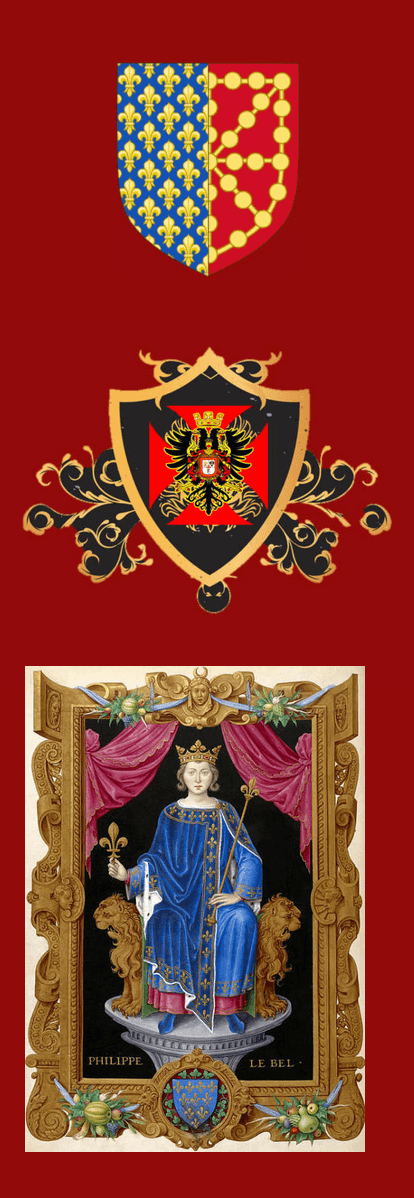
Sovereign Spanish Magistral Order of the Knights Templar
Philip IV of France
For other monarchs, see Philip IV (disambiguation). For other monarchs with the name of “Philip the Beautiful”, see Philip the Beautiful.
Philip IV the Beautiful King of France King of Navarre, Count of Champagne and Brie Philippe IV le Bel.jpg King of France 5 October 1285 – 29 November 1314 Predecessor Philip III Successor Louis X King of Navarre Count of Champagne and Brie (Next to Joan I) 16 August 1284 – 4 April 1305 Predecessor Joanna I Successor Louis X of Navare
Born July 1, 1268 Fontainebleau, France Death November 29, 1314 Fontainebleau, France Burial Basilica of Saint-Denis Family Dynasty Capetos
Father Philip III Mother Elizabeth of Aragon Consort Joanna I of Navarre Descend Louis X Philip V Charles IV Isabella of France Royal Coat of Arms of Navarre (1285-1328).svg Shield of Philip IV the Beautiful Philip IV of France, called Philip the Beautiful (Fontainebleau, July 1, 1268 – November 29, 1314), was king of France and Navarre.
A member of the Capeto dynasty, he was the second son of King Philip III the Atrevido and his first wife Elizabeth of Aragon. He had as her preceptor William of Ercuis, his father's former chaplain in his youth. Both his enemies and his admirers nicknamed him "The Marble King" or "The Iron King".
- He stood out for his rigid and severe personality. One of his staunchest opponents, the Bishop of Pamiers Bernard Saisset, said of him, “He is not a man or a beast. It is a statue.”[citation needed] Pope Boniface VIII treated him as “falsifier.”
- The death of his older brother, Louis, poisoned at the age of 11 (1276), made him the heir of his father, to whom he succeeded his death (5 October 1285). He was a hunting-fan king and proud of the greatness of his lineage (he promoted the canonization of his grandfather Louis IX of France). He knew how to surround himself with competent advisors and councillors who shared his ideas and thanks to this strengthened the central power of the King of France, both nationally and internationally.
Among its advisors, it is worth mentioning the figure of Enguerrand de Marigny. That policy evolved the monarchy. It strengthened the Crown, especially in the financial aspect, with the institution of a court of accounts and the replacement of personal military benefits from vassals for taxes on money intended to hire mercenaries.
The expulsion of the Jews in 1306 also responded to economic phones. As for his title as king of Navarre, when his wife Juana died in 1305, he passed the title to the son of both Louis I of Navarre. To cleanse the finances of the kingdom of France, he bought the Quercy from the English for a payment of 3,000 pounds. He unjustly attacked those who had money, which involved the religious of the Catholic Church, the Lombards, the Jews and the Templars.
To obtain the passage of the French army, in order to evacuate the Guyena, Philip promised his sister, Margaret of France, in marriage to King Edward I of England. Afterwards, he engaged his own daughter Elizabeth of France, with the English heir resulting from the first union (the future King Edward II of England). The conflict with Pope Boniface VIII Since the beginning of the reign of Philip the Beautiful had conflicts between the ecclesiastical lords and the royal officers for the exercise of all kinds of rights over men and lands, which were generally resolved in favor of royal jurisdiction, despite the protests of the bishops and the pope.
The new Pope Boniface VIII, elected on Christmas Eve 1294, set out to assert his full potestatis over the kings and in 1296 he promulgated the decretal epistle or secular bulla Clericis in which he forbade the sovereigns any tax levy on the clergy without pontifical authorization, under penalty of excommunication. The papal bull provoked a brief period of tension with King Philip that was soon solved by a compromise.2 Boniface VIII, who then had other concerns such as the conflicts with the Aragonese of Sicily and the Colonna, was in hardship and gave in soon.
- The Roman bulls mater (February 1297) and Etsi de statu (July 1297) caused the king to win the cause. This latter document contained a formal renunciation of the claims issued in the decretal epistle Clericis lay, in defense of ecclesiastical goods against the arbitraryness of the kings.
- In the late summer of 1301 the arrest of the bishop of Pamiers, Bernard Saisset, by order of the king under the accusation of treason, triggers a very serious conflict with Pope Boniface VIII, because the detention constituted a clear violation of ecclesiastical privileges, since only the pope could judge a bishop.
The reason for the arrest was to force a solution to the conflict over the jurisdiction of Pamiers who confronted the Count of Foix, who had the support of the king, and the Church that had the intervention of the pope who had placed that diocese under his direct protection. However, the ultimate goal had much more depth because it sought to uproot Boniface VIII from recognizing the supreme jurisdiction of the king over all his subjects, including the members of the high ecclesiastical hierarchy, that is, a recognition of the absolute superiority of the king over the pope within his kingdom.2
On October 24 in Senlis, before Philip and his council, the charges were brought against the bishop, whose gravity, according to the king, justified his intervention: Saisset would have tried to drag the Count of Foix into a plot aimed at the rising of the Languedoc against the king; in addition, he would have spread a false prophecy of St. Louis, king of France, according to which the dynasty of the Capets would lose the kingdom under the reign of his grandson. However, the minutes of the process show no evidence to prove those allegations.
A few days later the royal advisor and celebrated legist William of Nogaret sends a letter to Boniface VIII to justify the king's performance, in it he extends the accusation of traitor to that of heretic (he is accused of having claimed that fornication was not sin and that the sacrament of penance was useless).
Thus the rebel against the king also became a rebel against God.2 "This text is of great historical importance. It is indeed the first where the religious transformation of real power is manifested. (...) Nogaret declared in the name of Philip the Beautiful and addressing Boniface VIII an unprecedented and consequences-filled principle: What is committed against God, against faith or against the Roman Church, the king considers it committed against him (...)
The kingdom becomes a mystical body whose head, that is to say the king, is invested with all the powers to preserve the unity of the faith."2 Philip attempted to obtain the misere from the pope, but Boniface, in the bull Ausculta fili (Listen, son), made public on 5 December 1301, reproves the French king for not having taken into account another bull, the Clericis lay people on taxes
In France, the bull was burned, and instead of the "Ausculta Fili", a counterfeit Bull (probably the work of Pierre de Flote) called Deum time circulated immediately. Its five or six high lines were thought to include a careful phrase: ... Scire te volumnus quod in spiritualibus et temporalibus nobis subes (i. e., we want you to know that you are our subject in both spiritual and temporal matters). As if this were not enough, it was also added that the one who denied it was a heretic (which was an hurtful phrase for "the grandson of St. Louis"). Boniface VIII summons the French bishops to Rome to try King Philip, guilty of unheard of abuses against the Church.
Philip responds in 1302 by accusing the pope of heresy at the meeting of the representatives of the clergy and nobility and for the first time of the city of Paris, which constitutes the birth of the States General of France, and also calls for a general council to judge him.
The king, in the words of Nogareth, had become the "angel of God" sent to act on his behalf. This "pontifical" conception of the king's power will appear again amplified in 1307 in the process against the Templars, during which Philip is defined as "minister of God" and "champion of faith" to which "the defense of the Church" belongs, of which the king was to "hold account to God."2 Boniface VIII through the bull Unam Sanctam declared, on the contrary, the supremacy of the spiritual power over the might of the Church
In fact, he tried to establish a Western theocracy. The legislators falsified the bull to render her insulting against civil power and against France [citation needed]. With the support of the people and the ecclesiastics, the king sent his counselor and future Guardasels, the knight William of Nogaret, with a small escort armed to Italy, in order to arrest the pope and to do so by a council.
Nogaret met with a personal enemy of Boniface VIII, Sciarra Colonna, a member of the Roman nobility, who pointed out that the pope was taking refuge in Anagni in Italy. Nogaret and Colonna arrived at Anagni and found the pope alone in the great hall of the episcopal palace, abandoned by his supporters.

The 68-year-old man was sitting on a high seat, dressed as a ceremony and did not react to the disruption of the armed troop. Seeing William of Nogaret and Sciarra Colonna approach, he slightly bowed his head and declared: "Behold my head, behold my tiara: I will die, it is true, but I will die as Pope." William of Nogaret backed down, impressed, while Sciarra Colonna, in his hatred of Boniface VIII, advanced insolently and slapped him with his iron mitt.
- With the violence of the coup, the old man fell strikyly from his throne. Shortly thereafter, the city’s population, ashamed of having left the pope, headed to the palace and stopped the French. But it was too late: the violence of which he had been a victim had definitively broken the reason for Boniface VIII. The pope died a month later without recognizing his relatives and refusing extreme uncrying.
- This episode was called the "Anagni attack" and occurred in 1303. This huge scandal splashed Philip the Beautiful, although he was not directly responsible, but those who did not know it, deduced that it was better not to oppose the king of France. The death of Boniface VIII allowed Philip IV to have French popes elected (Benedict XI in 1303 and Clement V in 1305).
- The king also found in Pope Clement V a more malleable personality that was under his power. So, among other things, he asked for the suppression of the Order of the Temple in 1307, after a seven-year trial to which about fifteen thousand men were subject, including the Grand Master, Jacques de Molay, who along with two other Templars, was burned in Paris for alleged heresy.3On 13 October 1307, the Templars were taken to prison, by order of King Philip, after having tortured them to have been tortured
The Grand Master of the Order, Jacques de Molay, perished at the stake in Paris in 1314.4 Foreign Policy Philip IV maintained an expansive interest to the east, towards the French-speaking regions east of the Saona River. Count Otto IV of Burgundy asked the French king for help to shake off the ties with the Empire that the Rodolph I kings of Habsburg and Adolf of Nassau imposed.5 On 2 March 1295, the French king obtained a treaty with the Count of Burgundy, by which the marriage commitment of Joan, daughter of the Count of Burgundy, was agreed with a son of the King of France, who would be Philip
The civil war began in the county, the king of the Romans allied himself with the English king to secure imperial rights in the county. However, the French money made the German king break the alliance with England and withdraw from the conflict with France.6 King Philip IV of France intervened in the county and in 1297 assumed control of the territory.7 The wedding of Joan of Burgundy took place with Philip the Largo and took place in 1307, but in 1318 as king he confirmed to Joan the hereditary possession of the county, once her male son was ruled.8 In 1312 Lyon was incorporated
In 1308 the attempt of the candidacy of his brother Charles of Valois as king of the Romans failed, since the papacy needed a balance of power to free him from French pressure.10 Scandal of the tower of Nesle Main article: Scandal of the tower of Nesle In April 1314, months before the death of Philip the Beautiful, there was a great scandal.
Margaret of Burgundy, lady of Louis X of France, already king of Navarre (for her mother Joanna I of Navarre), and Blanca of Burgundy (v. 1296-1326), wife of Charles (future Charles IV of France) were denounced by Elizabeth of France, daughter of Philip the Beautiful and Queen of England.
The king's daughters-in-law would have deceived her husbands with the brothers Philip of Aunay and Gauthier of Aunay, both knights of the royal palace. The political implications were so severe that the punishment they were given was exemplary. The two lovers were tried and convicted of the crime of lesa majesty, being executed in the public square of Pontoise. Splacked alive, their genitals were cut off and thrown at the dogs. Eventually they were beheaded and their bodies washed and hung by the armpits to the gallows.
Such cruelty is explained by the affront made to the royal family, but also by endangering the legitimacy of the descent of the dynasty. Margarita de Burgundy was condemned to wear the hair shaved and driven in a car covered with black sheets towards Château-Gaillard. He occupied a cell open to the winds at the top of the tower, where he died in 1315.
Some say she was strangled, but her conditions of imprisonment do not question a death from body wear. White of Burgundy was also shaved, but benefited from a "favorable treatment", compared to that of his cousin Margaret, because he was the wife of the youngest son, not the future king of France.
She was locked underground for seven years and then obtained permission to take the religious habit. She became queen of France while still in prison, on 21 February, until her marriage was annulled on 19 May 1322 by Pope John XXII. Third, Countess Joan of Burgundy, sister of Blanca, wife of the future king of France Philip V, was locked up in Dourdan as an accomplice for having kept secret about the love affairs.
Supported by her mother Mahaut of Artois, she reconciled with her husband, when she was already King Philip V and became queen of France in 1317. Felipe the Beautiful died after a hunting accident, as a result of a spill in a non-motor area of the brain, on November 29, 1314 in Fontainebleau.
His remains were buried in the Basilica of Saint-Denis. At his own request, his heart was taken to the monastery of Poissy in the company of the Great Cross of the Templars. His grave, like that of other princes and dignitaries who rested there, was desecrated by the revolutionaries in 1793. He was succeeded by his son Louis X of France, “Luis the Stubborn.”
