

Sovereign Spanish Magistral Order of the Knights Templar
The Crusades
The Crusades were a series of religious wars driven by the Catholic Church during the Middle Ages. These military campaigns were declared to recover for Christianity the region of the Near East known as the Holy Land, which was under the rule of Islam.
Other expeditions armed with the purpose of conquering Muslim territories previously Christian, as in Spain, of implanting Christianity, as in Prussia, or even of suppressing by force movements against the power of the Church, as in the south of France, were also finally known as Crusades.
The Crusades of the Eastern Mediterranean, the first to which this name was applied, were carried out by feudal and sovereign lords of Western Europe, especially those of Capet France and the Holy Roman Empire, but also of England and Sicily, at the request of the Papacy and, in principle, of the Empire of the East. They took place over a period of almost two centuries, between 1096 and 1291, led to the ephemeral establishment of a Christian Kingdom in Jerusalem and the temporary conquest of Constantinople.
Wars with religious sanction in Spain and Eastern Europe, some of which culminated in the 15th century, were classified as crusades by the Church. They focused on the fight against the Muslim rulers of Spanish territories, against the pagan Slavs and Baltics (Prussians and Lithuanians above all) and in some case against the Eastern Empire or the Ottomans. In the crusade against the Albigenses the struggle was against dissident Christians and the nobles who supported them, especially against the followers of Catharism. In many cases, the crusades were the cause of persecution against Jews, Greek and Russian Orthodox Christians.
The participants of the Crusades, known as Crusaders, took religious vows temporarily and were granted indulgence for their sins. Í On the reasons French Knights of the Fifth Crusade arrive at the fort of Damieta (present-day Egypt) in 1249. The Crusades were undertaken to liberate the Holy Places, that is, the regions where Jesus Christ lived, from Muslim domination.
They began in 1095, when the Byzantine emperor Alexius I requested protection for the Christians of the East to Pope Urban II, who in the Council of Clermont began the preaching of the Crusade. At the end of his address with the Gospel phrase “renounce thyself, take up thy cross, and follow me” (Matthew 16:24), the multitude, excited, loudly manifested his approval with the cry Deus lo vult, or God wills it.12
Possibly, the motivations of those who participated in them were very diverse, although in many cases it can be a real religious fervor. It is argued, for example, that they were motivated by the expansionist interests of the feudal nobility, the control of trade with Asia and the hegemonic eagerness of the papacy on the monarchies and the churches of the East, although they declared themselves with principle and object of reclaiming the Holy Land for the pilgrims, of which the Seljuk and Zangui Turks, once conquered Jerusalem in 1076, abused without mercy, they abused without mercy,
On the term The origin of the word and why they put it like this, it is attributed to the cross of cloth used as a badge in the outer clothing of those who took part in this company of reconquest of the Holy Land.
Medieval writers use the terms crux (transmarine crossover, Statute of 1284, cited by Du Cange, s.v. crux), croisement (Joinville), croiserie (Monstrelet), etc. Since the Middle Ages, the meaning of the word cross was extended to include all wars waged in the performance of a vote and directed against infidels, e.g. against Muslims, pagans, heretics, or those under edict of excommunication.4
- The wars that since the 8th century maintained the Christian kingdoms of the north of the Iberian Peninsula against the Muslim Caliphate of Cordoba, and which historiography knows as Reconquista, continued equally discontinuously since the 11th century against the kingdoms of taifas, the Almoravids and the Almohads. On some occasions, the pope granted them the qualification of “crusade”, as happened with the battle of Las Navas de Tolosa (1212) or with the final episode of the Reconquista: the War of Granada (1482-1492). In northern Europe, crusades were organized against the Prussians and Lithuanians.
The extermination of the Albigensian heresy was due to a crusade and, in the 13th century, the popes preached crusades against John Without Earth and Frederick II Hohenstaufen. But modern literature has abused the word by applying it to all religious wars, such as, for example, the expedition of Heraclius against the Persians in the 7th century and the conquest of Saxony by Charlemagne. Again the term resounded during the first half of the 20th century, used by the Axis powers or their circle of influence: the Spanish civil war or the German invasion of the USSR, received such a qualifier from official propaganda.
However, used with a strict criterion, the idea of the crusade corresponds to a political conception that occurred only in Christendom from the 11th to the 15th century. It was a union of all peoples and sovereigns under the leadership of the popes. All the crusades were announced by preaching. After delivering a solemn vow, each warrior received a cross from the hands of the pope or his legacy, and was from that moment considered a soldier of the Church.
Crusaders were also granted temporary indulgences and privileges, such as exemption from civil jurisdiction or inviolability of persons and property. Of all those wars waged in the name of Christianity, the most important were the Eastern Crusades, which are those dealt with in this article

Consequences of the Crusades Religiously: They demonstrated the religious unity of the East and the power of the Church; Socially: The Crusades weakened the feudal lords; many lost their lives or remained in the East; others were impoverished by the sale of their land; in addition, the prolonged absence prevented them from monitoring their rights. The kings seized the vacant fiefdoms and tenaciously reduced the privileges of the lords. For their part, the servants and vassals reached their freedom in exchange for money.
The cities and the bourgeoisie benefited from the gains provided by the provisioning, transport of armies and increased traffic with the East. The French, the main participants of the Crusades, enjoyed an influence in the Eastern countries that reached until the contemporary era. Economically: New crops and manufacturing procedures taken from Muslim peoples were introduced into the West.
Trade, especially maritime, gained greater momentum. The ports of Genoa, Venice, Amalfi, Marseille and Barcelona were the most favored. Culturally: Arab and Byzantine art and science improved Western culture; customs experienced sensitive changes and the gender of life became less rough.5 6
Background Europe and the Mediterranean in the time of the first crusade. The Seljuk dynasty in its largest period. In order to understand what reasons the leaders of Europe and the Middle East had to make such decisions, we must go back to the years immediately preceding the beginning of the cross phenomenon and know the background of the crusades.
- Around the year 1000, Constantinople was the most prosperous and powerful city in the “known world” in the West. Located in an easily defensible position, in the midst of the main trade routes, and with a centralized and absolute government in the person of the Emperor, in addition to a capable and professional army, they made the city and the territories governed by this (the Byzantine Empire) a nation without torque in the whole orb. Thanks to the actions undertaken by Emperor Basil II Bulgaroktonos, the enemies closest to its borders had been humiliated and annulled in their entirety.
- However, after the death of Basil, less competent monarchs occupied the Byzantine throne, while a new threat emerged from Central Asia on the horizon. They were the Turks, nomadic tribes who, over the course of those years, had converted to Islam. One of those tribes, the Seljuk Turks (named after their legendary leader Selyuq), launched against the Constantinople Empire. At the Battle of Manzikert, in 1071, the bulk of the imperial army was razed by Turkish troops, and one of the co-emperors was captured.
- In the wake of this debacle, the Byzantines had to cede most of Asia Minor (today the core of the Turkish nation) to the Seljuks. Now there were Muslim forces stationed a few kilometers from Constantinople itself. Moreover, the Turks had also advanced in the south direction, towards Syria and Palestine. One after another the cities of the Eastern Mediterranean fell into their hands, and in 1070, a year before Manzikert, they entered the Holy City, Jerusalem. These two events shocked both Western and Eastern Europe.
- Both began to fear that the Turks would slowly dominate the Christian world, making their religion disappear. In addition, numerous rumors began to come about torture and other horrors committed against pilgrims in Jerusalem by the Turkish authorities. The first crusade was not the first case of Holy War between Christians and Muslims inspired by the papacy. Already Pope Alexander II had preached war against the Muslim infidel twice.
- The first was in 1061, during the conquest of Sicily by the Normans, and the second in the framework of the wars of the Spanish Reconquest, in the crusade of Barbastro of 1064. In both cases the pope offered Indulgence to the Christians to participate.7 In 1074, Pope Gregory VII called the Christi militias ("soldiers of Christ") to be in aid of the Byzantine Empire after its heavy defeat at the Battle of Manzikert.8
His call, while widely ignored and even received quite a bit of opposition, along with the large number of pilgrims traveling to the Holy Land during the 11th century and to whom the conquest of Anatolia had closed the land routes to Jerusalem, served to focus much of the attention of the West on the events of the East.
In 1081, a capable general, Alexius Comneus, ascended the Byzantine throne, who decided to vigorously confront Turkish expansionism. But he soon realized that he could not do the work alone, so he began rapprochements with the West, even though the western and eastern branches of Christianity had broken up relations in the Great Schism of 1054.
Alexius was interested in being able to have a Western mercenary army that, together with the imperial forces, attacked the Turks at their base and sent them back to Central Asia. He wished in particular to use Norman soldiers, who had conquered the kingdom of England in 1066 and by the same time had expelled the same Byzantines from southern Italy. Because of these encounters, Alejo knew the power of the Normans.
And now I wanted them as allies. Alejo sent emissaries to speak directly with Pope Urban II, to ask for his intercession in the recruitment of the mercenaries. The papacy had already shown itself capable of intervening in military affairs when it promulgated the so-called "True of God", which prohibited combat from Friday at sunset until Monday at dawn, which markedly diminished the contests between the noble quarrels. Now it was another opportunity to demonstrate the power of the pope over the will of Europe.
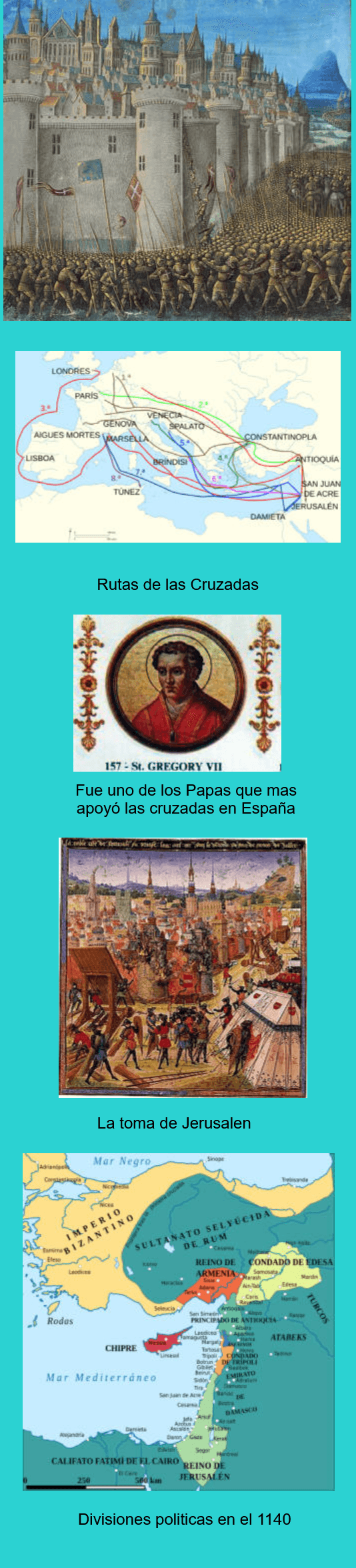
Routes of the Crusades. In 1095, Urban II convened a council in the city of Plasencia. There he exposed the Emperor's proposal, but the conflict of bishops attending the council, including the pope, with the Holy Roman Emperor, Henry IV (who was supporting an anti-pope), prevailed over the study of Constantinople's request. Alexejo would have to wait.
European society, in its future, had accumulated considerable war potential. On the other hand, Islam had been erected in a dangerous and strong enemy. Both things came together and gave rise to the crusades, projected by Western Christianity to save the Eastern Christianity of the Muslims.
The result, however, was far from the purposes and, in purity, the cross-moving, historically considered, was a debatable failure (though more than a hundred years of trade prove otherwise). Steven Runciman summarizes it this way:[citation needed] When Urban II preached his great sermon in Clermont, the Turks were about to threaten the Bosphorus. When Pope Pius II preached the last crusade, the Turks were crossing the Danube.
Rhodes, one of the last fruits of the movement, fell into the possession of the Turks in 1523, and Cyprus, ruined by the wars with Egypt and Genoa, and finally annexed to Venice, passed to them in 1570. All that was left for the Western conquerors was a handful of Greek islands that Venice held precariously in its power.
- The Turkish advance was contained by the joint effort of Christianity, and by the action of the States to which Venice and the Habsburg Empire concerned, with France, the former protagonist of the holy war, helping the infidel in a continuous way. There were eight crusades from the 11th century to the 13th century.
First Crusade Main article: First Crusade Gregory VII was one of the popes who most openly supported a crusade in the Iberian Peninsula. Gregory VII was one of the popes who most openly supported the crusade against Islam in the Iberian Peninsula10 and who, in view of the successes achieved, conceived to use it in Asia Minor to protect Byzantium from the Turkmen invasions.11
His successor, Urban II, was the one who put it into practice. The formal appeal took place on the penultimate day of the Council of Clermont (France), on Tuesday, 27 November 1095. In an extraordinary public session held outside the cathedral, the pope addressed the crowd of religious and laity gathered to communicate a very special news. Showing their gifts as a speaker, he laid out the need for Western Christians to commit themselves to a holy war against the Turks, who were exerting violence on the Christian kingdoms of the East and mistreating the pilgrims who went to Jerusalem. He promised remission of sins for those who came, a mission to the height of God’s demands, and a hopeful alternative to the unfortunate and sinful earthly life they led.
They should be ready to leave the next summer and would have divine guidance. The crowd responded passionately with shouts of Deus lo vult ('God wants it!') and a large number of those present knelt before the pope requesting his blessing to join the sacred campaign.12 The first crusade (1095-1099) had begun.
The passage of the Crusaders through the Kingdom of Hungary The preaching of Urban II first set in motion the multitude of humble people, led by the preacher Peter of Amiens the Hermit and some French knights. This group formed the so-called popular crusade, crusade of the poor or crusade of Peter the Hermit. Disorganizedly they headed for the East, causing massacres of Jews in their path. In March 1096 the armies of King Coloman of Hungary (nephew of the recently deceased King Ladislaus I of Hungary) repelled the French knights of Valter Gauthier who entered Hungarian territory causing numerous robberies and massacres in the vicinity of the city of Zimony.
- Later the army of Peter of Amiens would enter, which would be escorted by the Hungarian forces of Coloman. However, after the Amiens Crusaders attacked the escort soldiers and killed about 4000 Hungarians, the armies of King Coloman would maintain a hostile attitude against the Crusaders who crossed the kingdom towards Byzantium. Capture of Jerusalem during the first crusade. Despite the chaos that emerged, Coloman allowed the cross- armies of Volkmar and Gottschalk into the income, who eventually had to face and defeat near Nitra and Zimony, who like the other groups caused incalculable havoc and assassinations.
- In the particular case of the German priest Gottschalk, he entered Hungarian soil without the king's authorization and established a camp in the vicinity of the settlement of Táplany. By slaughtering the local population, Coloman, a rabies, forcibly expelled the invading Germanic soldiers. Afterwards the Hungarians would arrest the forces of Count Emiko (who had already killed on German soil about four thousand Jews) near the city of Moson. Coloman immediately banned Emiko's stay in Hungary and was forced to confront the siege of the Germanic count to the city of Moson, where the Hungarian king was located.
- The forces of Coloman bravely defended the city and, breaking the site, managed to disperse the cross forces of the besieger. Soon, the Hungarian king forced Godfrey of Bouillon to sign a treaty in the abbey of Pannonhalma, where the Crusaders pledged to pass through Hungarian territory with peaceful behavior. After this, the forces would continue out of Hungarian territory escorted by the armies of Coloman and head towards Constantinople. Upon his arrival in Byzantium, the Basileus rushed to send them to the other side of the Bosphorus.
- They were carelessly entered Turkish territory, where they were easily annihilated. The Crusade of the Siege Princes of Jerusalem in 1099. Much more organized was the so-called Princes Crusade (usually referred to in historiography as the first crusade) around August 1096, formed by a series of armed contingents coming mainly from France, the Netherlands and the Norman kingdom of Sicily. These groups were led by the seconds of the nobility, such as Godfrey of Bouillon, Raymond of Toulouse and Bohemund of Taranto. During their stay in Constantinople, these chiefs swore to return to the Byzantine Empire those territories lost to the Turks.
- From Byzantium they headed to Syria through the Seljuk territory, where they achieved a series of surprising victories. Already in Syria, they laid siege to Antioch, which they conquered after a seven-month siege. However, they did not return it to the Byzantine Empire, but Bohemund retained it for itself by creating the Principality of Antioch. With this conquest the first crusade ended, and many crusaders returned to their countries. The rest remained to consolidate possession of the newly conquered territories.
Together with the Kingdom of Jerusalem (originally directed by Godfrey of Bouillon, which took the title of Defender of the Holy Sepulchre) and the principality of Antioch, the counties of Edessa (present-day Urfa, in Turkey) and Tripoli (in present-day Lebanon) were also created. After these initial successes there was a wave of new fighters who formed the so-called crusade of 1101. However, this expedition, divided into three groups, was defeated by the Turks when they tried to cross Anatolia. This disaster extinguished the cross spirits for a few years.
Second Crusade Main article: Second Crusade Political divisions of the area around 1140. Thanks to the division of Muslim states, the Latin (or Frankish, as they were known to the Arabs), managed to establish themselves and endure. The first two kings of Jerusalem, Baldwin I and Baldwin II were rulers capable of expanding their kingdom to the entire area between the Mediterranean and the Jordan, and even beyond.
They quickly adapted to the changing system of local alliances and came to fight alongside Muslim states against enemies who, in addition to Muslims, had Christian warriors among their ranks. However, as the spirit of crusade was declining among the Franks, increasingly comfortable in their new way of life, among the Muslims was growing the spirit of jihad or holy war stirred by the preachers against their ungodly rulers, capable of tolerating the Christian presence in Jerusalem and even allying with their kings.
This sentiment was exploited by a series of warlords that managed to unify the different Muslim states and embark on the conquest of the Christian kingdoms. The first of these was Zengi, governor of Mosul and Aleppo, who in 1144 conquered Edessa, liquidating the first of the Frankish states. In response to this conquest, which revealed the weakness of the Crusader States, Pope Eugene III, through Bernard, abbot of Claraval (famous preacher, author of the rule of the Templars) preached in December 1145 the second crusade.
Unlike the first, in this one they participated kings of Christianity, led by Louis VII of France (accompanied by his wife, Eleanor of Aquitaine) and by the Germanic emperor Conrad III. The disagreements between French and Germans, as well as with the Byzantines, were constant throughout the expedition. When both kings arrived in the Holy Land (separately) they decided that Edessa was an unimportant target and marched towards Jerusalem. From there, to the despair of King Baldwin III, instead of confronting Nur al-Din (son and successor of Zengi), they chose to attack Damascus, an independent state and ally of the king of Jerusalem.
The expedition was a failure, as after only a week of unsuccessful siege, the Crusader armies withdrew and returned to their countries. With this useless attack they managed to get Damascus to fall into the hands of Nur al-Din, who was progressively encircling the Frankish States.
Later, the attack of Baldwin III on Egypt was to provoke the intervention of Nur al-Din on the southern border of the kingdom of Jerusalem, preparing the way for the end of the kingdom and the convocation of the third crusade As the different halvus crusades of nine were followed.
