
Sovereign Spanish Magistral Order of the Knights Templar
Order of Montesa
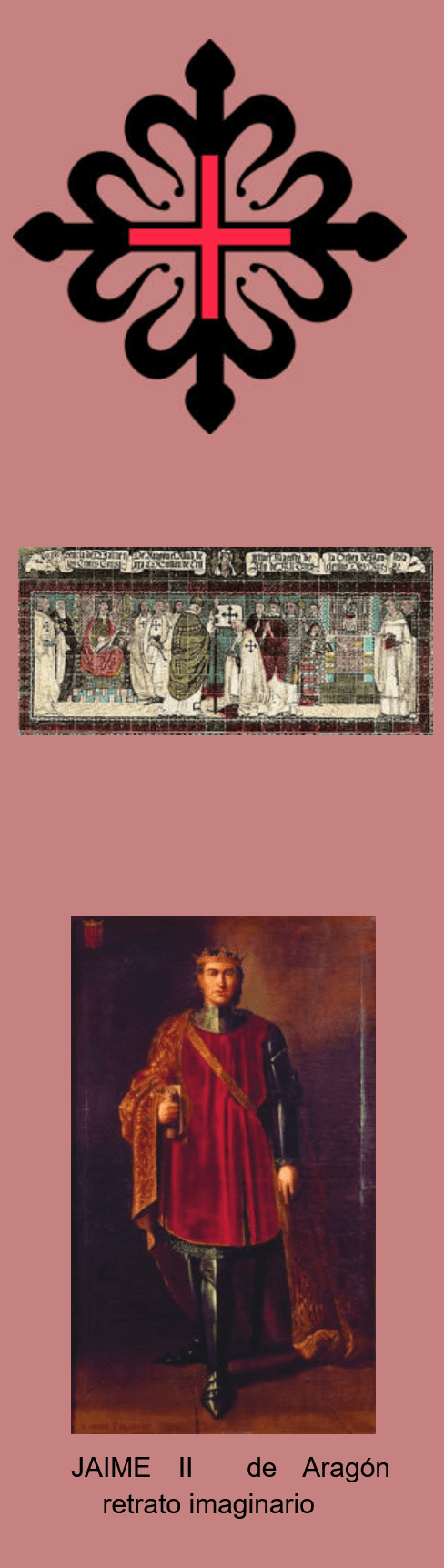
The Order of Saint Mary of Montesa and St. George of Alfama is a religious and military order founded by King James II of Aragon in the 14th century (1317). It currently survives as a corporation of an honorary and noble character
The King of Aragon gave to the order the Castle of Montesa, located near the border with the Saracens in the Kingdom of Valencia. It was approved by Pope John XXII on June 10, 1317, by bull, approving and confirming the Order of Montesa as proposed by King James II of Aragon, investing the goods of the order of the Templars extinguished by Clement V in endowing a new order that sought to found the aforementioned king.
The foundation was verified on Sunday, July 22, 1319, in the royal chapel of the palace of Barcelona, being the head and sacred convent of it that of the town of Montesa, of which the king made donation to the order, and of which he took its name. He took a red cross without flowers, and the white capitular mantle which Clement VII approved on 5 August 1397. But later, on the occasion of having incorporated into this order in 1399 that of St. George of Alfama, he left that badge and adopted a cross of red gules by concession of Benedict XIII, granted in 1400 and which Martin V later confirmed. The order suffered numerous difficulties.
According to the foundation bull, it was the master of Calatrava who was responsible for the creation of the new order, as well as the ability to arm the knights and make the Montesan knights dress.
James II, in advance, had written the teacher of Calatrava to accelerate the action. The master, who did not like to obey orders or his own king, that of Castile, did not even answer the letters. The king then went to the pope to give the order to that of Calatrava. The Pontiff passed the commission to the archbishop of Valencia, who also did not receive a response from the Master of Calatrava. The Archbishop of Valencia finally sent to Castile the abbot of the Monastery of Our Lady of Benifassà, belonging to the Order of the Cistercle.
The Master of Calatrava refused to go to Valencia, claiming that his obligations guarding the border prevented him, although the real reason seems to be that it was the unwillingness on the part of the Order of Calatrava to cede the possessions of Aragon to another order. Finally, he gave in and sent a prosecutor to Valencia to work on his behalf
- Evolution Foundation of the Order of Montesa. William of Eril, an old man, a great expert in the military arts, was named as the first Master of the New Order. The office lasted him very little, as Eril died seventy days after he was elected. The kingdom of Valencia was agitated due to the revolt known as the Union, by which some Valencian nobles, relying on the people, wanted to emancipate themselves from the tutelage of the Kingdom of Aragon and constitute themselves in an independent kingdom.
The king of Aragon commissioned the Master of Montesa, Arnaldo of Ferriol, to control the seditious, thus becoming the Montesans a very important asset for King Pedro IV of Aragon to defeat the rebels of Valencia. The Order became the main military force defending the throne.
Decline Ruins of the castle of Montesa, which was the seat of the Order until the 18th century. However, the kings were already beginning to take an active part in the choice of the Masters. King Ferdinand II of Aragon (Fernando el Católico) imposed as such his nephew, Philip of Aragon and Navarre, thus revoking the previous appointment.
The last Master was Pedro Luis Garcerán de Borja, Marquis of Navarres, son of the Duke of Gandia, brother of St. Francis of Borja, elected at the age of 17. In 1572, a court of the Inquisition of Valencia convicted Garcerán de Borja of sodomy.2 It seems that Pedro Luis Garcerán de Borja had been in love long before a certain Martín de Castro, a ruffian dedicated to prostitution and pimping, both men and women, and that he was caught in bed with the Count of Ribagorza, John II of Ribagorza.
Martín de Castro, before being executed in 1574 in court, betrayed Pedro Luis Garcerán de Borja, giving out rugged details and showing his lack of scruples. Garcerán de Borja, who had been viceroy and captain general of the kingdoms of Tremecén, Tunisia, Oran and Mazalquivir, was compromised by the internal crisis suffered by the Order of Montesa, divided into factions, and by the enmities created by promoting his favorites.
Philip II, who was consulted by the Inquisition on the convenience of judgment, decided to use the process to teach the Levantisque nobility a lesson, while neutralizing the Borja alliance with the Portuguese royal family.
Garcerán de Borja was sentenced to 10 years in prison in the convent of Montesa and a fine of 6000 ducats, at the rate of 1000 ducates a year. However, as early as 1583, Garcerán de Borja, after internal disputes over the succession of the Grand Master, knew how to ingratiate himself with the King and negotiated with Philip II the incorporation into the crown of the last Order that remained independent on December 8, 1587, thanks to a bull of Pope Sixtus V issued in Rome.
As a prize he obtained the Mayor's Encomienda de Calatrava and in 1591 the Viceroyalty of Catalonia, dying in 1592.2 The convent of the Order was in the village of Montesa. An earthquake in 1748 caused the rock on which many of its members to collapse and kill. The Order went on to have its center in Valencia, in the house of the Temple.
Masters of the Order of Montesa
- Guillermo de Eril (1317-1319)
- Arnaldo de Soler (1319-1327)
- Pedro de Thous (1327-1374)
- Alberto de Thous (1374-1382)
- Berenguer March (1382-1409)
- Romeo de Corbera (1410-1445)
- Gilaberto de Monsavin (1445-1453)
- Luis Despuig (1453-1482)
- Felipe Vivas de Cañamanes y Boll (1482-1484)
- Felipe de Aragón y Navarra (1484-1488)
- Felipe Vivas de Cañamanes y Boll (1488-1492)
- Francisco Sanz (1493-1506)
- Francisco Bernardo Despuig (1506-1537)
- Francisco Llansol de Romaní (1537-1544)
- Pedro Luis Garcerán de Borja (1545-1587)
- Reyes de España (1587-...)
