
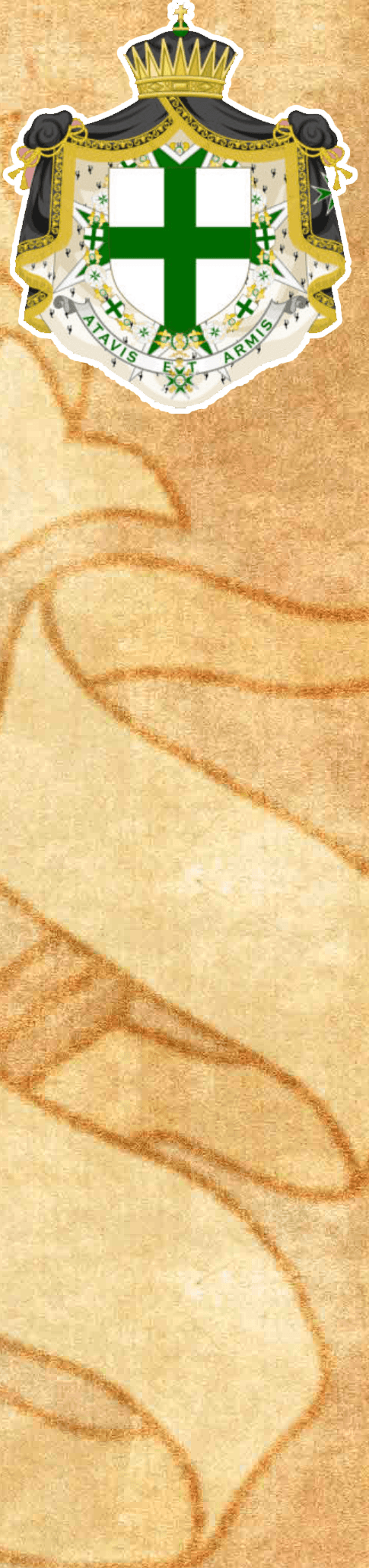
Sovereign Spanish Magistral Order of the Knights Templar
Order of St. Lazarus
The Military and Hospitaller Order of St. Lazarus of Jerusalem is an honorary cavalry order Centuries before the Crusades took effect, already existed in the Holy Land charitable institutions that took care of the assistance to pilgrims who came to visit the places witnessing the Passion of Jesus Christ.
The Order in the Crusades The result of the First Crusade was the seizure of Jerusalem in 1099, the Crusaders (in command of Godfrey of Bouillon) took possession of the city and converted it into the capital of the Crusader Kingdom of Jerusalem.
- The monks of St. Lazarus, who previously took care of the lepers, were quick to offer their services to the new kingdoms. It is curious that the Lazarists welcomed any knight of another Order who contracted leprosy and was well received among them, provided that he kept his Rule.
From the year 1115 they formed an independent community among the Eastern Orders, since some cross knights took the role of the previous monks, taking the Rule of St. Augustine.
A bull of Pascual II can be cited, confirming the Rule and another in 1255 of Pope Alexander IV, who, two years earlier, had placed them under the protection of the Holy See. While this was happening, the Knights of St. Lazarus took part in a battle, that of Gaza, on October 18, 1244, in that battle all the fighters were killed.
- Others, of the same Order, fought along with the Templars, the Hospitallers and the Teutonics, also under St. Louis, in the disastrous battle of Mansura (1250) and were also part of the St. Louis Crusades and in the expeditions to Syria (1250 to 1254).
The soldiers of the Sultan of Cairo besieged the fortress of St. John of Acre, which was in the hands of the Christians from the first crusade.
In command of the defenders were The Masters of the Orders of the Temple and St. Lazarus. Both chiefs perished in battle and after heroic resistance, St. John of Acre was taken over by the Muslims in 1291.
And with this fact the fall of the whole Latin kingdom of Jerusalem was determined. Before this happened, the Order of St. Lazarus recognized by several Pontiffs, including Innocent IV and Paul V, had great possessions in the region of Palestine, but when Sultan Saladin occupied Jerusalem, he gave a year of term to the Hospital Orders to leave the city.
The king of France Louis VII who had undertaken the Second Crusade for penance, when he returned to his country, in the year 1149 he took with him twelve brothers of St. Lazarus and in 1154, he made a donation to the Order of the castle of Boigny, so that it would establish its general entrustment, so the Order spread throughout numerous cities of France.
- For his part, a certain English nobleman, who admired the Order, introduced in England the Lazarists, who fixed their domiciliation in the city of Burton Lazars. All these events brought about a great change in the Order because, protected by kings, there came a time when it was more powerful in Europe than it had been in Asia.
- But in the crusades they were not so successful, after the fall of St. John of Acre, the Lazarists who survived went to take refuge in the island of Cyprus. Others settled in Sicily, in Capua, where they spread throughout Italy.
- The French branch of Boigny and the Italian branch of Capua were the most important, but this was not for them to found priories and encomiendas, apart from that of Burton, in Hungary, Flanders and other countries of Europe.
The Order after the Middle Ages Shield of the Order of St. Lazarus. In the year 1490, Pope Innocent VIII made the decision to unite the Order of St. Lazarus to that of St. John of Jerusalem, however the French branch continued autonomous, so Pope Leo X annulled the unification ordered by his predecessor. For his part, the King of France Henry IV, united the Order of St. Lazarus the Carmel, in view of the fact that the latter languished and its unification with a more powerful one was convenient.
The Order of St. Lazarus did not neglect, much less, its military obligations or its struggle against the Turkish power. In the 17th century the Lazarists armed a fleet to fight against the privateers and pirates, choosing the port and city of Saint Maló as the center of their maritime operations.
The Order gathered up to ten frigates and fought courageously defending the safety of the French coasts. Even in the 17th, Pope Gregory XIII issued a bull in which he commanded to incorporate the Order of St. Lazarus into that of St. Mauritius, thus forming the so-called Order of St. Maurice and St. Lazarus, and which became one of the most distinguished in Italy. Something similar to the previous occasion occurred, when another Pope tried to incorporate her into that of St. John of Jerusalem.
The Priory of Sicily complied with the pontifical bull, but the same thing did not happen with the Grand Master of the Boigny Lazarists who, with several priories and encomiendas, continued their independent life.
Among the great Masters of the 15th century are: the Marquises of Nerestang, of Luvois, of Dangeau, the Duke of Berry, then Louis XVI and then the Count of Provence, later king with the title of Louis XVIII.
As Knights of the Order of St. Lazarus in other countries, the Tsars of Russia, Paul I and Alexander I and Archduke Leopold of Austria, the Dukes of Seville, can be quoted.
King Louis XVIII of France and later Charles X, declared themselves protectors of this Order. In France there were three important, very old Orders: that of the Holy Spirit, that of St. Louis and that of St. Michael. Next to the previous Orders was that of the Lazarists.
The demands imposed by the entry into the Order of St. Lazarus: Nine degrees of nobility, without known principle, or going back to an uncertain date. After the turbulent times before the contemporary era, the Order of St. Lazarus, remained, not extinguishing like some other Military Orders of Cavalry.
She is currently represented in France, Germany, Italy, Poland, the Netherlands, Switzerland, Portugal and Spain. On June 26, 1935, the Order registered its Statutes in Spain. On May 9, 1940 it was officially recognized and declared of public utility throughout the national territory, by order that was published in the Official Gazette of the State on the 10th of the same month. Its regulations on the fight against leprosy were approved by the Decree of 8 March 1946, which grants and assigns to the Military and Hospitaller Order of St. Lazarus of Jerusalem, important missions.
The members of this Order are divided into two groups: the members and the affiliates. Only the first and even among these, only the Knights of Justice, can attend the Chapters of their respective Priories. Apart from those of Justice there are those of Devotion. They can all be knights, ladies or ecclesiastics, but it is absolutely necessary to profess the Catholic religion. Insignia of the Order.
After the reunification of the two Obediences previously existing (Obedience of Malta and Paris Obedience) occurred at the international conference of the Order held in Toronto in 2004 and ratified by a large majority in the face of the candidacy of Prince Charles Philip of Orleans, the 48th Grand Master of the only Military and Hospitallery Order of St. Lazarus of Jerusalem, Bethlehem and Nazareth was Francis of Paula de Borbón
In solemn investiture session of the Order of St. Lazarus, held in Manchester on September 12, 2008, he was appointed 49th Grand Master of the Military and Hospitaller of St. Lazarus of Jerusalem, Bethlehem and Nazareth Carlos Gereda and of Bourbon, who in 2018 would succeed Francisco de Borbón and von Hardenberg as 50th Grand Master, leaving his father, the Duke of Seville
The members, Knights of Justice, are obliged to prove in an undoubted way, the legitimacy of their ascendants to the second civil degree inclusive, the nobility of one hundred years of two of their surnames, one of whom will always be the first by the paternal line and the other, either the second of the aforementioned line, or the first of the maternal; this is at the choice of the suitor to admission.
The Knights of Justice use as a badge a green octagonal cross, embroidered on the frac or uniform, as well as on their chapter cloaks. Categories are: Grand Necklace, Grand Cross, Commander and Knight. Only members, not so affiliates, are authorized to wear the Order uniform, dark blue cloth, with white collar and sleeves, pits and galloned pants. Saber or sprat, it depends on the acts. Pointed hat and patent leather boots.
The Order is governed by the Grand Master who is for life and is authorized to appoint a coadjutor. There is also a Supreme Consultative Council and an International Secretariat of Chamber and Government that, respectively, guide the Grand Master in those matters in which his opinion is requested, and assist him directly.
Affiliates, those who practice proof of nobility are referred to as "nobles of merit" and those dispensed from them are considered solely "of merit."
Both the first and second can have the same degrees as the limbs, but they do not carry the embroidered cross. For these, there is the so-called "Merit" cross, divided into four categories, as well as medals, awarded for relevant services. Military and Hospitaller Order of St. Lazarus of Jerusalem, Bethlehem and Nazareth.
