Sovereign Spanish Magistral Order of the Knights Templar
Order of Santiago
The Order of Santiago is a religious and military order that emerged in the 13th century in the kingdom of León. It owes its name to the patron saint of Spain, Santiago the Major. Their initial goal was to protect the pilgrims from the Camino de Santiago and to expel Muslims from the Iberian Peninsula. The Order had its origin in the city of Cáceres from the previous Order of the Fratres of Cáceres.
The bishop of Santiago de Compostela encouraged this conversion in exchange for the order, in its reconquering advance to the south, did not claim the return of the archbishopric to Mérida, where it had been until the invasion of the Muslims recommended its transfer to the north, to Santiago de Compostela.
After the death of the Grand Master Alonso de Cárdenas in 1493, the Catholic Monarchs incorporated the Order to the Crown of Spain and Pope Hadrian VI forever united the mastery of Santiago to the crown in 1523.
The first Republic abolished the Order in 1873 and, although in the Restoration it was re-established, it was reduced to a noble institute of an honorary character governed by a Higher Council under the Ministry of War, which was in turn extinguished after the proclamation of the second Republic in 1931.
The Order of Santiago, together with those of Calatrava, Alcantara and Montesa, was reinstated as a civil association in the reign of John Charles I with the character of honorary and religious nobility organization, and as such remains since the end of the twentieth century.
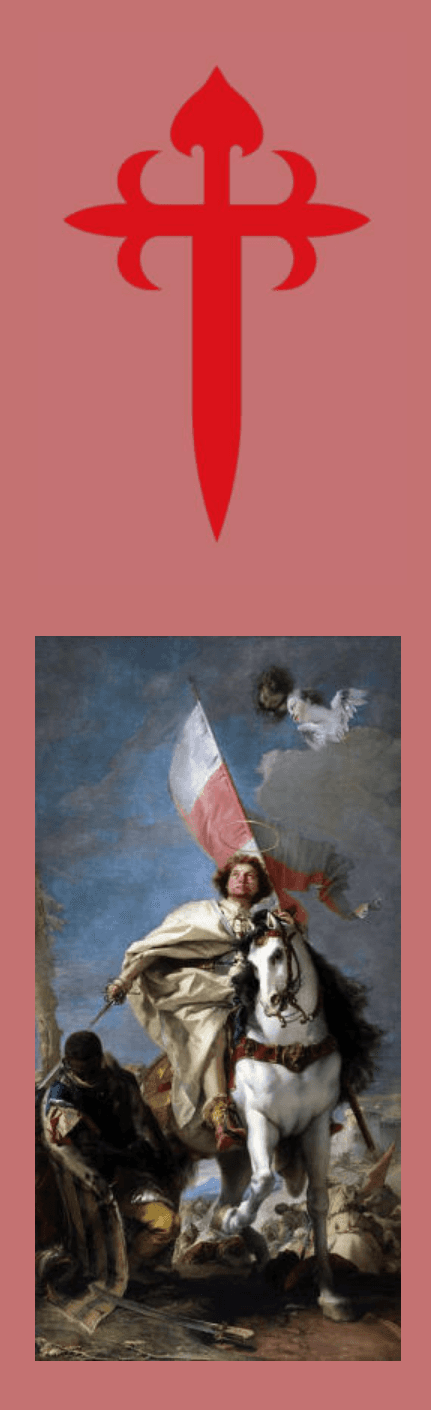
The insignia of the Order is a gules cross simulating a sword, shaped like a lys flower on the grip and on the arms. The knights carried the printed cross on the banner and white cape. The bander cross had one venerate in the center and another at the end of each of the arms.
The two flowers of the lateral limbs represent the unblemished honor, which refers to the moral features of the apostle's character.3 The sword represents the chivalrous character of the apostle James and his form of martyrdom, since he was beheaded with a sword. It can also symbolize, in a sense, taking the sword in the name of Christ.
It is said that their form has origin in the time of the Crusades, when the knights wore small crosses with the sharp lower part to nail them to the ground and perform their daily devotions.4 In reality history tells us that it arises in the Spain of the Reconquista, after the battle of Clavijo (23 May 844).
History Origin
Representation of Santiago the Elder as Santiago Matamoros, carrying the mantle of his Order. Giovanni Battista Tiepolo (Museum of Fine Arts, Budapest). Between 1157 and 1230, the royal dynasty was divided into two opposing branches, so the rivalry tends to obscure the beginnings of the Order. Although Santiago de Compostela, in Galicia, is the center of devotion to this apostle, it is neither the cradle nor the main seat of the Order. Two cities fought to have the honor of being the seat of the Order, Leon, in the old kingdom of that name, and Ucles in the new kingdom of Castile.
Some sources point out that the Order of Santiago was created in the wake of the victory in the battle of Clavijo, which supposedly took place in La Rioja in the year 844.5 Although the attribution to the creation of the Order after that battle, which today is considered a fictional fact that never took place,6 is due to the devotion to the apostle, to which the legend attributes an intervention in said combat, so that the representation of this battle is constantly repeated in paintings
Military Foundation
The origin of this military order is confusing, due to the double foundation that the military orders had. The first foundation was military, when in 1170 King Fernando II of León and the bishop of Salamanca, Pedro Suárez de Deza, commissioned a group of thirteen knights, known as the Fratres or Knights of Cáceres, the defense of the city of Cáceres, which they had to abandon when conquered by the Muslims.
This group of knights was headed by Pedro Fernández de Fuentencalada, who was a descendant of the kings of Navarre, by paternal line, and from the counts of Barcelona, by the maternal.8 The rest of the gentlemen stand out: Pedro Arias, Count Rodrigo Álvarez de Sarria, Rodrigo Suárez, Pedro Muñiz, Fernando Odoarez, lord of the Varra and Arias Fumaz, lord of Lentazo. According to the founding bull, these knights, repentant of the licentious life that until then they had led, had previously joined under the same statutes and decided to form a congregation to defend the pilgrims who visited the tomb of Santiago Apóstol in Galicia and to keep the borders of Extremadura.
- Alfonso VIII of Castile and Leonor de Plantagenet deliver the castle of Ucles to the master of the Order of Santiago Pedro Fernández de Fuentencalada (Magister P. Ferrandi[z]), a fact that happened on January 9, 1174. Miniature belonging to the Tumbo menor de Castilla (National Historical Archive). About the cartoons you can see the legends: ALIENOR : REGINA | ALFONSUS REX : | MAGISTER : P : FERRANDI[Z] | CASTELLUM DE : UCLES | QUIDAM FRATER. Eleanor, queen; Alfonso, king; master P. Fernández; castle of Ucles and a friar (literally 'brother'), respectively.
- Prior to 1170, the first to come to the relief of the many pilgrims heading to Compostela were the regular canons of St. Augustine. They lived under the obedience of a chosen prior and confirmed by them in the convent called San Loyo or San Eloy de Loyo, near Compostela, founded by example of the knights of the Order of Calatrava, which was also intended to protect the safety of roads.
- Over the years many hospitals were erected to house pilgrims, from the Pyrenees to the aforementioned city of Compostela. For an effective defense, the Freires—or Knights—of Cáceres determined to associate themselves with those religious and were forced by solemn vow to keep and defend those ways. The canons, accepting the offer of the knights, agreed to receive them in their Order, live with them in community and be their chaplains to direct them spiritually and administer the sacraments. It was then that the Freires of Cáceres changed their name to that of Freires de Santiago, thus organizing the Order.
In the foundation of the Order participated Cerebruno and Pedro Gundesteiz, archbishops of Toledo and Santiago de Compostela; Juan, Fernando and Esteban, bishops of León, Astorga and Zamora, respectively, as well as the papal delegate, Cardinal Jacinto. On July 29, 1170, the Order of Santiago was founded, organized and established, and in 1172 it had spread to Castile.
Although the Order of James had been born in the kingdom of Leo, it also spread through the kingdoms of Portugal, Aragon, France, England, Lombardy, and Antioch, but its fundamental expansion would be limited to the kingdoms of León and Castile. The Knights of Avila were added to their rule.7 9 Alexander III religious foundation approved the religious creation of the Order by a bull granted on July 5, 1175.
- The religious foundation must be attributed to King Alfonso VIII of Castile, with the approval of Pope Alexander III through a bull granted on July 5, 1175 in Ferentino, near Rome, in order that they should be raised in fear of God:10 ... and for the remedy of human weakness, marriage is allowed to those who could not be continents; keeping the woman the uncorrupted faith and the wife to the husband, because the husband is not broken In this bull he approved his constitutions and made it exempt from the jurisdiction of ordinary or ordinary friars, whose grace later ratified the Popes Lucius III, Urban III and Innocent III by different bulls that also arranged the state of the knights and that of the religious.
- From this moment they were known by the name of Knights of Santiago, since that of Knights or Freires of Ucles, which appears in some ancient documents, did not prevail.7 As an effect of this double foundational act—real institution and pontifical approval—the Order was constituted, like a Militia Christi, with both religious and military vocation, whose mission was the “service of God, the exaltation and defense of the Christian.
- All of Spain considers James the Elder as the first to preach the gospel to the inhabitants of Hispania. Later, he returned to Jerusalem, where he was the first of the apostles to shed his blood at the command of Herod Agrippa I and, according to tradition, his disciples moved his body to Spain and deposited it in Iria Flavia (Galicia) in the early ixth century. His relics were discovered during the reign of Alfonso II the Chaste thus beginning the evolution of pilgrims towards his tomb being Theodomir bishop of Iria Flavia and being in the 17th century when the episcopal see moved to Compostela.
It is natural that the knights should be entrusted in a special way to the patronage of James when entering battle, and it is logical that they should often believe that heavenly protection was felt by the favorable intervention of the apostle. For this reason, according to the second Archbishop of Compostela, Pedro Godoy, on February 12, 1171 Pedro Fernández and his entire militia were consecrated vassals and knights of the apostle James, appointing the master and his canon successors of the Compostela church and the archbishop and his friars of the new Order of cavalry. So everyone would henceforth be appointed Knights of James and so the pope would name them in his bull.
There is still a picture of great proportions that represents the moment when Pedro Fernández, accompanied by the first knights wearing his white layers with the red cross of Santiago as the emblem of the Order, presents Pope Alexander with the rule for his confirmation. This painting was hung for many years on the left side of the nave of the church of the monastery of Ucles. Today it is preserved in the sacristy of the monastery until it is restored.8 Ucles, seat of the Monastery Order of Ucles, seat of the Order of Santiago. Cloister of the monastery of Ucles.
The Knights of Santiago had possessions in the following kingdoms of the Iberian Peninsula: León, Castilla, Aragón and Portugal; but Fernando II de León and Alfonso VIII of Castile put the condition that the seat of the Order should be in their respective states: in San Marcos de León and Uclés. Hence a long conflict that only ended when, in 1230, Ferdinand III the Saint, united both crowns. Since then, Ucles, in the province of Cuenca, is considered to be the headquarters of the Order, Caput ordinis.
After the departure of the Frates of Cáceres from the kingdom of León, forced by the loss of Cáceres, its primitive headquarters, and the places they had acquired in the territory of Badajoz, before the thrust of the Almohads, they passed to Castile, where they were well received by their king Alfonso VIII. This, he gave the castle of Ucles to the Knights of Santiago to defend that region and that of Huete from the Muslim attacks. The castle had belonged from 1163 to the knights of St. John, but the king was unhappy with his performance—for in the period in which they occupied him they did nothing notorious—and withdrew possession of the border castle in favor of the Santiagos. On January 9, 1174, the solemn act took place in Arévalo, by which Alfonso VIII delivered the castle and the town of Uclés, with all its lands, vineyards, meadows, grasslands, streams, mills, fisheries, ports, entrances and exits, to the master of the Order, Pedro Fernández de Fuentencalada. The event was attended by the prelates and nobles of the kingdom and Alfonso VIII together with his wife Eleanor of England.8 At the end of that same month the knights of the Order of Santiago took possession of the town and fortress donated by Alfonso VIII, an act attended by the Archbishop of Santiago.
- The flag of Santiago, which the archbishop had delivered to them in Compostela, first waved in the tower of homage. The church of Santa María del Castillo changed its name to that of Santiago until the convent was built with a new church suitable to the needs of the Order. In Ucles was the monastery where the great master of the Order habitually resided, this monastery was destroyed in the sixteenth century to build the present monastery that began to be built in 1529 and was completed in 1735. The applicants spent a year and a day of trial in the monastery. The archives of the Order that were in Ucles passed in 1869 to the National Historical Archive in Madrid.
- The Order received its first article12 in 1171 from Cardinal Jacinto—later Pope Celestine III—and in 1175 the papal bull of Alexander III.8 Main events The Santiaguista knights were present in all the warrior actions of the Reconquista and its territories were extended mainly by La Mancha. To this Order belonged towns of the current provinces of Ciudad Real, Cuenca, Toledo, Madrid, Guadalajara, Jaén and Murcia. The first notorious military action in which they intervened was to help the army of its protector Alfonso VIII in the seizure of the city of Cuenca, in 1177. His contribution to this conquest was so important that the king added, in the newly conquered terrain, new donations to the Order, among them: Two houses near those of Aben-Mazloca, in the same alcázar of Cuenca, two plots, a mill in the Moscas River and an orchard near this river. With the donations made to Tello Pérez and Pedro Gutierrez, which in turn donated to Pedro Fernández, the founder of the Order, the Santiago Apóstol Hospital in Cuenca was soon created.
- One of the thirteen collisions13 in which the city was divided was also called Santiago, leaving his church within the enclosure of the same cathedral.8 Alfonso VIII also gave Uclés to Pedro Fernández to settle there and defend the border, according to Royal Scripture extended in Arévalo on January 3, 1174, being since then the main house of the Order. He also gave to the Moya Order in 1211, which would later be joined by Ossa de Montiel, Campo de Criptana, Pedro Muñoz, Montiel and Alhambra. The congregation prospered, acquiring goods and territories and came to form a kind of diocese with capital in Ucles, whose prior had almost episcopal authority. The rapid spread of the Order was due to the fact that its rule was less rigid than those of the other orders—it is the only military order whose knights could marry—eclipsing the oldest of Calatrava and Alcantara and whose power was reputed abroad even before 1200. The first confirmation bull, that of Alexander III, already listed a large number of endowments.
The Order of Santiago alone had more possessions than the orders of Calatrava and Alcantara together. In Spain, these assets included 83 parcels, of which three were reserved for large commanders, two cities, 178 counties and villages, 200 parishes, five hospitals, five convents and the University of Salamanca. The knights were then 400 and more than 1000 spears could be gathered. They had possessions in Portugal, France, Italy, Hungary and even Palestine. Abrantes, his first commission in Portugal, dates from the reign of Alfonso I, in 1172, and soon became a distinct Order, since Pope Nicholas IV, in 1290, frees her from the jurisdiction of Uclés.14 Gonzalo Ordóñez was elected great master of the Order in León, at the same time as Gonzalo Rodríguez (1195). He went to Castile and served Alfonso VIII. On the death of the previous master in 1203, he was elected in Ucles and only lived two more years.15 Santiaguista Knights during a battle of the Reconquista.
In the time of the third master, Sancho Fernández de Lemus, the Almohads commanded by the Caliph Abu Yaqub Yúsuf al-Mansur (Yúsuf II), winner at the Battle of Alarcos in 1195 against Alfonso VIII and where they found the death of nineteen Santiago, carried out a general offensive by lands of Castile, reaching Uclés two years later. The master, in the midst of the bewilderment of the Christian kingdoms, resisted in the Uclesian castle with his people, while other fortresses, such as those of Madrid and Guadalajara, submitted to Yúsuf II.8 16
- The knights of Santiago participated in the reconquest of the regions of Teruel and Castellón and fought in the battle of the Navas de Tolosa (1212), in which the master Pedro Arias died along with a large number of Santiago knights. After the death of Alfonso VIII in 1214 riots occurred in the Order. In 1233 his knights went to the battle of the takeover of Jerez de la Frontera and, three years later, to the conquests of Úbeda and Córdoba. Pelayo Pérez Correa was the master who gave the most splendor to the Order, inducing Fernando III the Saint to put room for Seville. During this site, 270 knights led by his master went too much into the mountain range and when night came without having achieved the complete defeat of the enemies, the Virgin Mary appeared, to whom they asked to stop the course of the sun pronouncing the deprecation: “Saint Mary, stop your day”. In remembrance of this event, the hermitage of the Virgin of Tentudy was later built, where they say that the master was buried in 1275. Pérez Correa was succeeded by Gonzalo Ruiz Girón, who died from the wounds received in Alcaudete in 1280.16 After the death of Vasco Rodríguez de Coronado, master of the Order between 1327 and 1338, the council of the Thirteen, so called because he was composed of thirteen gentlemen appointed from among the governors and commanders of the Order, elected as master the nephew of this, Vasco López.
- By the personal intervention of King Alfonso XI of Castilla in order to retain the position for his bastard son, the infant Fadrique Alfonso de Castilla, son of Leonor Núñez de Guzmán and nephew of Alonso Meléndez de Guzmán, the latter was appointed master in 1338 and the election of Vasco López was annulled, citing defects in the election. The king’s interference in the succession rules of the Order provoked great disputes, since legally the masters were elected among the Friers with a vow of chastity, with consent and subsequent appointment by the pope. The comments of this about Alonso and, above all, Leonor made him an enemy of the king. Alonso de Guzmán fought alongside the king in the conquest of the kingdom of Algeciras, but was killed by him to finally appoint the infant Fadrique, 8 years old, as master of the Order in 1342.17 In 1358, Fadrique was sent to assassinate in Seville by his half-brother, King Pedro I of Castile, who appointed in his place Juan de Padilla, brother of the king's favorite, Maria de Padilla. However, the knights of the Order refused to recognize him and defeated him near Ucles, Padilla dying during the fight.
- The later masters, Fernando Osórez, Pedro Fernández and Pedro Muñiz, died in the war with Portugal, but the Order was replenished during the prolonged teacher of Lorenzo Suárez de Figueroa, who founded the convent of Santiago de Sevilla.16 The Castilian-Leonese monarchs granted privileges to the Order that allowed to repopulate extensive regions of Andalusia and Murcia. During the fifteenth century, the Order moved its radius of action to Sierra Morena and took the population of Llerena (Badajoz) as a habitual place of residence of its teachers, providing a high growth in both this population and its surroundings.16 In 1453, Henry IV of Castile took over the administration of the Order until Alfonso of Castile reached the age of majority. Between 1462 and 1463 he appointed Beltrán de la Cueva provisional master. In 1463, when he was of legal age, the infant Alfonso de Castilla was appointed as the titular master. In 1474, Juan Pacheco, Marquis of Villena, abdicated in favor of his son Diego after seven years of government. This decision disgusted most of the knights and provoked a schism in the Order and great struggles, since, at the same time, Rodrigo Manrique and Alonso de Cárdenas intended the teachership. He was named Rodrigo by Uclés and Alonso by San Marcos.
On the death of Rodrigo Manrique, the Catholic Monarchs ended the disputes by staying with the administration for a while and appointing master Don Alonso, who accompanied them in the war of Granada.16 Incorporation into the Crown of Castile With the passage of time and the completion or slowdown of the Reconquista, the Order of Santiago was involved in the internal struggles of the Crown of Castile. At the same time, the immense goods of the Order forced it many times to sustain the found pretensions of the Crown. The title entailed great power, both territorial – it could be gone from Ucles to Portugal without stepping outside the territories of the Order – and economic – the master of the Order came to obtain an annual income of 64 000 gold florins.
Being the position of great master of such influence, internal struggles and flags were also frequent to achieve such dignity. To such an extent they had discredited the Order these scandals, that at the death of the great master Alonso de Cárdenas in 1493, the Catholic Monarchs found an excuse to ask the Holy See for a providence capable of putting an end to the scandals, while underlining the great expenses that the war of Granada had entailed to the Crown. Thus, the Kings asked Alexander VI to grant them the administration of the great mastery of the Order, a measure that could be considered as necessity and, at the same time, as a kind of reward of their great sacrifices for the Catholic faith. The pope agreed to the lawsuit and with bull of the same year granted the administration of the supreme dignity of the Order of Santiago to the Catholic Monarchs. After the death of Ferdinand the Catholic, the emperor Charles I succeeded him in the administration, at which time Pope Hadrian VI forever united the Masters of Santiago, Calatrava and Alcantara in 1523 to the Crown of Spain. Until then, the great master of Santiago was elected by the council of the Thirteen.
