
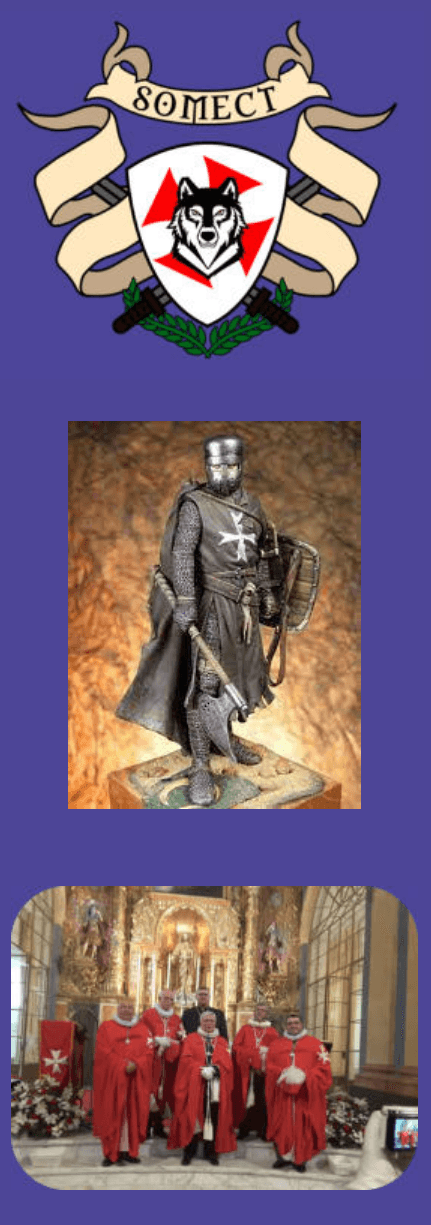
Sovereign Spanish Magistral Order of the Knights Templar
Hospital Order
A hospital order is a type of religious order that was intended to admit and care for travelers, pilgrims, the poor and the sick.
- They were also responsible for defending pilgrims in some cThe hospital orders generally owe their origin to some pressing and unforeseen need, to some destructive scourge that cannot be fought with ordinary means such as the fire of St. Anton, the Black Death, etc. and to the lodging and protection of pilgrims to the Holy Land, for example, which differentiated them from the Christian military orders, which had a spiritual objective centered on the crusade
The hospital orders included two classes: those dedicated exclusively to hospitality (hosting and healing of the sick: healing bodies healing souls, with the medieval Christian background of the disease-sin duality) and those that were both hospitable and military protection to pilgrims (aid and relief to the traveler who moves for religious reasons through rugged or dangerous territories).
The oldest of them was founded in Siena at the end of the 9th century by a pious inhabitant of that city who opened in it a hospital called Della Scala. Dangerous roads.
The military orders were religious-military institutions created in the context of the Crusades as societies of Christian knights (thousands Christi), initially for the defense of the Holy Places (Templary, Hospitallers and the Holy Sepulchre) and then applied to the propagation or defense of the Christian faith, either in the Holy Land or elsewhere, against the Muslims (such as the Spanish military orders during the Reconquista), against the pagans (such as the Order)
The knights of the military orders were subject to the canonical vows of the religious orders, being "half monks, half soldiers". Many orders were later secularized. With the name of "military", "equestrian" or cavalry orders, all kinds of institutions linked in different ways to the privileged estates (nobility and clergy) were multiplied since the end of the Middle Ages and during the Old Regime; identifying their members with distinctive habits and crosses, widely used in heraldics.
- In the Contemporary Age, lost their military and political functions and their economic power (deamortization), they have only an honorific and representative role of certain social circles; although the Sovereign Order of Malta continues to take on culsism-state consideration in international relations.
Functions
The main feature of religious military orders is the combination of military and religious ways of life. Some, such as the Knights of St. John and the Knights of St. Thomas, also took care of the sick and the poor, such as the Order of St. Lazarus of Jerusalem.
They were not exclusively male institutions, because the nuns could also associate themselves with a convent of the order (commendors). Without military functions, "unarmed orders" were also created: the redemptive orders of captives (trinitarians and mercedaries).
The religious members of the military orders could be, and indeed were often, subordinate to unordered siblings. Practically most of the members were not religious; there were very different degrees of belonging, from that of the monk-soldiers to that of the simple associated knights and all kinds of servants.
The governing position of a military order was denominated Grand Master. The role and function of military orders have often been obscured by fixation on their feats in Syria, Palestine, Prussia and Livonia.
They had possessions and members throughout Western Europe. They were the common thread of cultural and technical innovations, such as the introduction of batting in England by the Knights of St. John, or the banking infrastructure of the Templars.
