
Sovereign Spanish Magistral Order of the Knights Templar
Teutonic Order
The Teutonic Order (also Order of the Teuton Knights and Order of the Teutonic Knights of the Hospital of St. Mary of Jerusalem, in German Deutscher Orden; in Latin Domus Hospitalis Sanctæ Mariæ Teutonicorum) is a medieval religious-military order founded in Palestine in 1190 (Third Cross) during the siege of the fortress of St. John of Acre.
In 1198 it became a military order. Since the 19th century the order survives as a Christian organization of a charitable character.
The origins of the Holy Land Herman von Salza. The Order was created by German Crusaders and followed the model of the Order of the Temple and the Order of St. John of Jerusalem.
Founded in San Juan de Acre (Palestine) on November 19, 1190 during the Third Crusade after the takeover of Jerusalem by Saladin. Originally it was only a hospital organization that helped Christian pilgrims, then was reorganized as a military order, in the likeness of the Knights Templar, and obtained the official recognition of Pope Innocent III in 1198.
**Defeated the Europeans in the Crusades, the knights of the Teutonic Order moved to Venice and from there to Transylvania, where they built the Castle of Bran, until their expulsion in 1225 by King Andrew II of Hungary, apparently for trying to place themselves under papal and non-real sovereignty.**
In 1220 the Teutonic Knights established their headquarters in the fortress of Monfort in Palestine, which became the seat of the great masters in 1229.2 In 1266, the Saracens failed to take the fortress, but will return in 1271 and manage to take over the castle through a tunnel carved into the rock.
The Teutonic Knights were forced to take refuge in San Juan de Acre.3 Twenty years later, in 1291, the taking of Acre by the Saracens forced the Crusaders to withdraw from the Holy Land, prompting the order to reconsider their mission.
In 1203, after the promulgation of the Golden Bull of Rimini by Emperor Frederick II Hohenstaufen, the Grand Master of the Order, Hermann von Salza, and Duke Conrad I of Mazovia began the Baltic Crusades, with the intention of Christianizing the Baltic peoples.
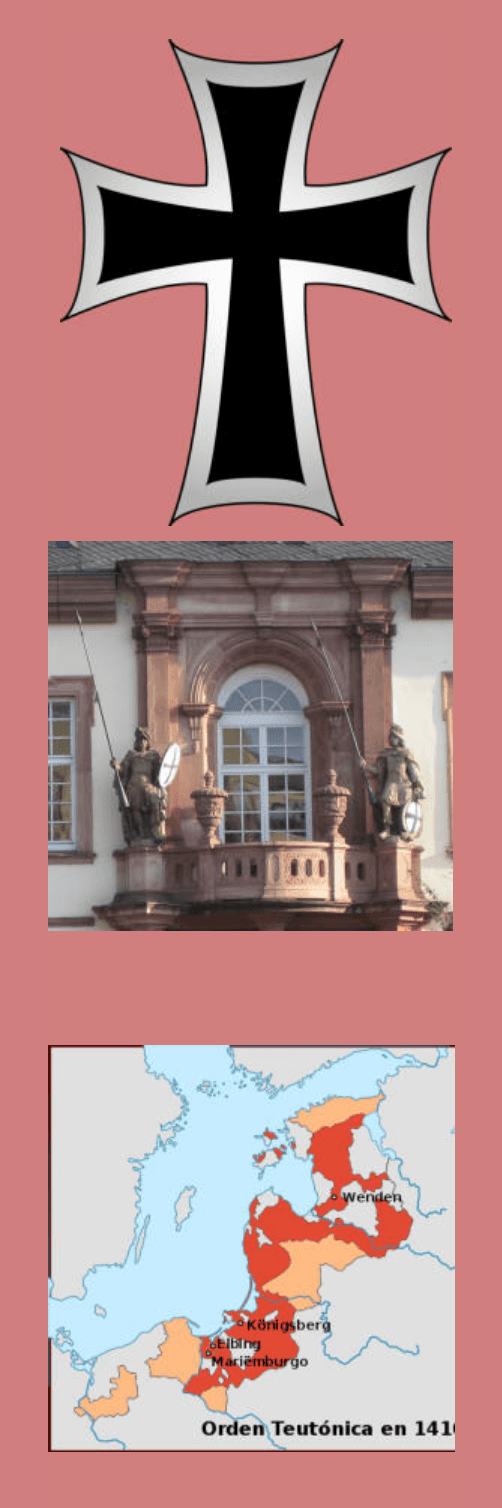
Teutonic State Main article: Monastic State of the Teutonic Order State of the Teutonic Order in 1410. Battle of Grunwald, by Jan Matejko (1878). House of the Teutonic Order in Frankfurt am Main. At that time the order was definitively established in Prussia creating an independent Teutonic Order State, also conquering Livonia.
Emperor Frederick II Hohenstaufen had granted the Teutons all the privileges of the princes of the Empire in the Golden Bull of Rimini, as the right of sovereignty over the conquered territories, with nominal papal sovereignty. The Kingdom of Poland, however, accused the order of controlling its territories by right.
The crusade had left wide population gaps in the conquered territory, a problem that was partially solved by encouraging the immigration of German settlers from the Holy Roman Empire and Mazovia. During this period of settlement and reconstruction, cities of importance such as Königsberg were founded, named in honor of Otakar II of Bohemia and Memel.
- By 1242, the order undertakes a campaign for the conversion of Novgorod Orthodox Christians. Despite a defeat to Russian Alexander Nevsky, the order rapidly extends its dominance over the Baltic countries.
- Also during the thirteenth century the Order was established in the Iberian Peninsula, with headquarters in the Castilian Encomienda de la Mota de Toro (today Mota del Marqués), where the church is still preserved, from there it spread to lands of Toledo and Seville, where the street of Germans today remembers its knights.
- From 1308 they occupied the whole of Prussia, extending to Estonia. This conquest included the Baltic regions of Pomerania, Curland, Latvia, Estonia and Dánzig, a city that was under its power until 1454.
- The order also had possessions in different points of the Holy Roman Empire. The following campaign of importance of the Order was the struggle for the conquest of Lithuania, especially after the fall of the Kingdom of Jerusalem in 1291. The war against the Lithuanians was especially brutal, as Lithuanian pagans were seen as beings devoid of the rights possessed by Christians.
- The war was very protracted, extending about two hundred years, even after the adoption of the Christian religion in 1387.
- At the end of the 14th century, the order reached the height of its power thanks to a powerful urban economy, as well as becoming a naval power in the Baltic Sea.
However, in 1410 they suffered a tremendous defeat at the Battle of Tannenberg in front of Grand Duke Vitautas of Lithuania and King Vladislaus II of Poland, so that the territories obtained by the Order passed into Polish and Lithuanian hands.
It then began a decline that culminated in 1525. Upon the production in Europe of the Protestant Reformation, his Grand Master Albert I of Prussia, renounced Catholicism and converted to Lutheranism to be Duke of Prussia.
