

Sovereign Spanish Magistral Order of the Knights Templar
SALADINO
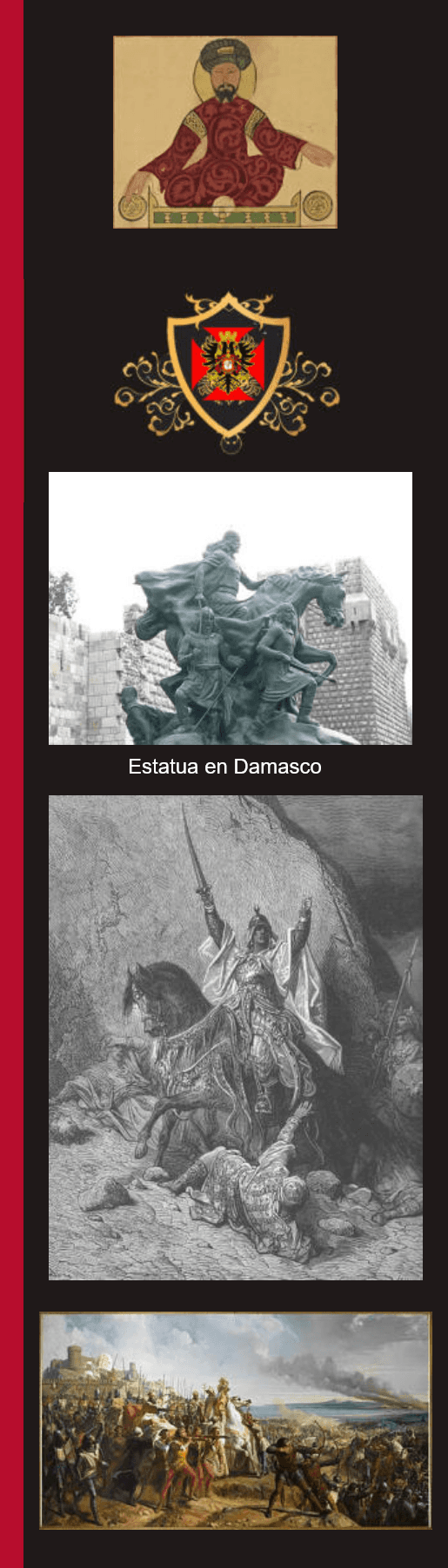
Saladino Ṣalāḥ ad-Dīn Yūsuf ibn Ayyūb Portrait of Saladin (before A.D. 1185; short).jpg Illustration of Saladin صلاح الدين يوسف بن أيوب by Ismail al-Jazari (before 1185).
- Sultan of Egypt and Syria 1174–4 March 1193
- Predecessor Al-Adid (in Egypt) As-Salih Ismail al-Malik (in Syria)
- Successor Al-Aziz Utman (in Egypt) Al-Afdal (in Syria)
**Personal information: **
- Birth يُوسُف بن بن أيوب بن شاذي بن مروان بن يعقوب الدُويني التكريتي name
- Name in Arabic صلاح الدين الأيوبي
- Birth 1138 Tikrit (Iraq)
- Death 4 March 1193
- Damascus (Roman Empire)
- Cause of death Infectious disease
- Sepulture Mosque of the Umayyads
- Religion Islam
**Family: **
- Nobiliary family Ayyubid dynasty
- Parents Najm ad-Din Ayyub Sitt al-Mulk Khatun
- Spouse Ismat ad-Din Khatun
- Children Al-Aziz Uthman
**Professional information: **
Military occupation. Conflicts Cross invasion of Egypt, Battle of Montgisard, Siege of the Kerak, Battle of Marjayoun, Battle of the Vado of Jacob, Battle of Belvoir, Battle of Affula, Battle of Sephoria, Battle of the Horns of Hattin, Siege of Jerusalem (1187 A.D.), Siege of Tyre, Siege of Acre, Battle of Arsuf, Battle of Jafa and Battle of the Horns of Hama. Title Sultan of Egypt and Syria [Al-Nāsir Ṣalāḥ ad-Dīn Yūsuf ibn Ayyūb (Kurdish: Selahedînê Eyûbî; in Arabic, صلاح الدين يوسف بن أيوب), better known in the West as Saladin, Saladin, Salahadin or Saladine (1138, Tikrit (Iraq)-4 of March 1193, Damascus),1 was one of the great rulers of the Islamic world
With him began the Ayyubi dynasty, which would rule Egypt and Syria after his death. Advocates of Islam and particularly of the religious orthodoxy represented by Sunism, he politically and religiously unified the Middle East by fighting and leading the fight against Crusader Christians and ending doctrines far removed from the official Muslim cult that represented the Abbasid Caliphate.
He is particularly known for having defeated the Crusaders in the Battle of Hattin, after which he returned to occupy Jerusalem for the Muslims and took the Holy Land. The impact of this event in the West sparked the Third Crusade led by Richard I of England that became mythical for both Christians and Muslims. His fame transcended the temporal and became a symbol of medieval knighthood, even for his enemies.
She remains a much admired figure in Arab, Kurdish and Muslim culture.
Childhood and Youth:
He was born in 1138 in Tikrit, (in the province currently called Salah ad Din in his honor, in Iraq), where his father Ayyub was governor. His family was Kurd, originally from Dvin in Medieval Armenia.34 Like many Kurds at the time, they were soldiers in the service of the Syrian and Mesopotamian rulers.5 After falling out of disgrace and being expelled in 1139, his father Najm ad-Din Ayyub and his uncle Assad al-Din Shirkuh, they placed themselves in the service of Zengi, lord of Mosul and Aleppo, who had joined them
He was the first of the great Muslim leaders who tried to drive the Crusaders out of the Middle East, managing to snatch the County of Edesa. Saladin’s family joined his army, his father being rewarded with the government of Baalbek. At that time Christians would launch the Second Crusade, which would fail. The violent death in 1146 of the Zengi warron unleashed civil war in Syria over the succession.
Saladin's family would be put on behalf of the appointed heir, Zengi's youngest son, Nur al-Din. When after various struggles he prevailed, Saladin’s relatives were rewarded: his father received the government of Damascus, and his uncle Shirkuh, the command of the army. Information about his childhood is scarce. Saladin wrote “children are raised in the way their elders were.” According to his biographer, al-Wahrani, he could answer questions about Euclid, the Almagest, arithmetic, law and other academic subjects of his time, but it is an ideal and it was the study of the Quran and theology that brought him closer to his contemporaries.

Many sources claim that his studies were closer to Islamic law and the Quran, typical of an cadi, which propitiated to the militia.7 It is believed that the seizure of Jerusalem by the Crusaders in the First Crusade, a great social event of the time, could have morally influenced him.7 He is also reputed with great knowledge in genealogies, biographies and stories of the Arabs, as well as of the lineages of Arab horses. Saladin knew Abu Tammam's Hamasah by heart.
Saladin's military career began under his uncle Shirkuh, general of Nur al-Din, who took over him. Fighting with the Christians Battle of Montgisard After leaving the mountains of al-Nusayri, Saladin returned to Damascus and licensed his Syrian troops. He left his brother Turan Shah in charge of Syria and marched to Egypt with his personal court, reaching Cairo on September 22.
After two years absent, he had a lot to supervise in the country of the Nile, particularly works and projects that he had left in Cairo. He repaired and expanded the city walls and began construction of the Citadel of Cairo.67 He also ordered the construction of the 85-meter well Bir Yusuf. His greatest public work outside the city was a large bridge in Giza, which aimed to facilitate the defense against blackberry invasions.68 Saladin remained in Cairo overseeing his government and building the Swordmakers’ Madrasa.
In November 1177, he launched a razzia over Palestine. The Crusaders had penetrated the territory of Damascus and Saladin took the truce as something that was no longer of value to preserve. The Christians sent a large portion of their army to besiege Harem, on the route from the Christian Antioch to Aleppo, neglecting its southern border.68 Saladin believed that the occasion was ripe and marched against Ashkelon, which he called the “girlfriend of Syria.”
William of Tyre records that the Ayyubid army consisted of 18 000 black slaves from the Sudan and 8 000 elite Turkmen and Kurdish soldiers. The army ravaged the countryside, plundered Ramla and Lod and reached the gates of Jerusalem.69 Saladin allowed King Baldwin to enter Ashkelon with the Knights Templar of Gaza without taking precautions against a surprise attack. Although the Crusaders had barely 375 knights, Saladin hesitated to ambush them in the presence of veteran troops and expert officers.
On 25 November 1177, with the bulk of his army absent, Saladin and his troops were surprised at Tell Jezer, near Ramallah. Before they could form in battle order, the Templars broke their lines. Saladin initially tried to organize his men, but at the death of his guard he saw the defeat inevitable and with the few remaining troops he had a camel mounted to Egypt.
- In the Christian chronicles it is known as the Battle of Montgisard.70 Without being discouraged by his defeat at Tell Jezer, Saladin prepared to fight with the Crusaders again. In the spring of 1178, he camped under the walls of Homs while skirmishes took place between his generals and the Crusaders. His troops in Hama won a battle and brought him the spoils of the enemy, with many prisoners to Saladin, who ordered his beheading to “wash the lands of the Believers with garbage.”
- He spent the rest of the year in Syria, without fighting with his enemies.71 The Spais of Saladin informed him that the Crusaders were planning an expedition in Syria. The Sultan ordered his general Farrukh-Shah to patrol the Damascus border with a thousand soldiers awaiting an attack to retreat without presenting battle and warning with torches in the hills for Saladin to march.
- In April 1179, the crossers led by Balduino, who expected no resistance to their surprise attack east of the Golan Heights, began the expedition. They advanced too fast in pursuit of Farrukh-Shah, which concentrated its troops southeast of Quneitra, and were defeated by the Ayubids in the so-called Battle of Maryayún.
- With the victory, Saladin brought reinforcements and requested five hundred horsemen from his brother al-Adil in Egypt.72 In the summer of 1179, Baldwin had built an outpost on the road to Damascus and intended to fortify a passage through the Jordan River, known as Jacob's ford, which controlled access to the plain of Banias, divided between Muslims and Christians.
- Saladin offered a hundred thousand pieces of gold to Baldwin in exchange for abandoning the project, particularly offensive as a holy place for Muslims, but there was no deal. Thus he resolved to destroy the fortress and moved its barracks to Banias. As the Crusaders rushed to attack their forces, they lost the formation. After an initial success, they pursued the enemy until they lost any order and were overwhelmed by Saladin’s troops.
- This battle of the Ford of James and the seizure of the fortress on August 30, 1179 was a key victory for Saladin.73 In the spring of 1180, while Saladin was in the vicinity of Safad, hoping to begin a new campaign, Baldwin sent messengers with peace proposals. After droughts and poor harvests, he was short of supplies and accepted.
Raymond III of Tripoli opposed the truce, but a raid on his lands and the vision of the Saladin fleet in Tartus convinced him.74 Caudillo of Islam Diplomacy in Peacetime Saladin assured the protection of the routes of caravans traveling to distant lands. In June 1180, Saladin received Nur al-Din Muhammad, ortuquid emir of Keyfa in Geuk Su, giving him and his brother Abu Bakr gifts worth a hundred thousand dynars according to Imad al-Din. He thus tried to establish an alliance with that dynasty and to impress other emirs of Mesopotamia and Anatolia.
She also offered to mediate between him and Kilij Arslan II, Sultan of the Rum, who claimed the land she gave as a dowry for her daughter who had complained about the treatment of her husband. Nur al-Din asked Saladin for help, but Arslan did not accept him as a mediator.75 Following the meeting with Nur al-Din, the most powerful of the Seljuk lords, Ikhtiyar al-Din al-Hasan, obtained the submission of Arslan, which forced an agreement.
Saladin later received a message from Arslan complaining of further abuse of his daughter, becoming angry. Saladin’s response was to threaten to attack Malatya, two days away, without getting off the horse until entering the city. Frightened by the ultimatum, the Turks negotiated. Saladin felt that Arslan was doing well when he cared about his daughter, but he could not abandon a vassal that had asked him for protection and betray him.
The final agreement gave the woman a year out of her husband’s home and Saladin’s commitment to abandon Nur al-Din if he failed to comply with the deal.75 Leaving Farrukh-Shah in charge of Syria, Saladin returned to Cairo in early 1181. According to Abu-Shama, he intended to pass the Ramadan fast in Egypt and then make the pilgrimage to Mecca (hajj). For unknown reasons he changed his mind and is known to have personally inspected the banks of the Nile in June. He confronted the Bedouins, who were dispossessed of two-thirds of their lands with which he rewarded the peasants of El Fayum whose property he had confiscated.
The Bedouins were accused of trading with the Crusaders, their grain confiscated and forced to settle further west. The Egyptian fleet also confronted the Bedouin pirates in Lake Tanis.76 In the summer of 1181, Saladin Karakush's eunuch and administrator led the arrest of Majd al-Din — former lieutenant of Saladin's brother Turan-Shah in Zabid, Yemen, while entertaining Imad al-Din at his expense in Cairo.
Those close to Saladin accused him of embezzlement of Zabid’s benefits, but Saladin said there was no evidence. He acknowledged the error and released Majd al-Din in exchange for compensation of 80 000 dinars and other sums to the brothers of Saladin al-Adil and Taj al-Muluk Bari.
This is one of several episodes in Yemen’s controversial Turan-Shah march. Although his lieutenants continued to send him benefits from the province, leadership was lacking and struggles broke out between the Izz al-Din Uthman of Aden and Hittan of Zabid. Saladin wrote in a letter to al-Adil: Yemen is a treasure house... we conquered it, but to this day we have had no benefits or advantages of it. There have only been countless expenses, shipments from our troops... and expectations that were not met in the end.
**Conquest of Mesopotamia **
The chief Zenguid prince, Saif al-Din, died in June of that year succeeding his brother Izz al-Din in Mosul.78 On 4 December, the son of Nur al-Din and theoretical head of the as-Salih family died after having made his officers swear allegiance to Izz al-Din, in an attempt to create a zenguid power that could compensate Saladin. Izz al-Din was welcomed in Aleppo, but his government's expectations as leader of the dynasty surpassed him and he exchanged Aleppo for Sinjar to his brother Imad al-Din Zangi. Saladin did not lend any opposition in respect of peace treaties with the family.79 On 11 May 1182, Saladin with half of his army and numerous non-combatants marched from Cairo to Syria.

On the night before his departure, he sat down with the guardian of one of his sons who quoted a verse: “Enjoy the perfume of Nechd’s bull’s eye plant, after this afternoon he will not come.” Saladin saw an evil omen and never saw Egypt again.78 Knowing that the cross-forces were gathering to intercept him, he crossed the desert of the Sinai Peninsula to Eilat and the Gulf of Aqaba. Without encountering opposition, he looted the Montreal countryside, while Balduino’s forces watched without intervening.80 He arrived in Damascus in June to discover that Farrukh-Shah had attacked Galilee, looting Daburiyya and taking Habis Jaldek, a stronghold of great importance.
In July, Saladin tasked him with attacking Kawkab al-Hawa, where he fought the battle of Belvoir Castle, which resulted in a draw. Later, in August, a land and sea attack was launched on Beirut for which he built 30 galleys, which was about to fail when Saladin retired to focus on the occasion in Mesopotamia.81 Kukbary, who ruled in Harran invited Saladin to occupy the region of Jaziera, in northern Mesopotamia. Saladin accepted and ended the truce with the Zenguids in September 1182.82 Before his departure to Jazira there had been intense struggles between the zenguids, many of whom did not want to recognize any primacy to Mosul.83 Before crossing the Euphrates Saladin River, Aleppo, thus declaring the end of the truce.
Once Bira was reached, on the bank of that river, he was joined by Kukbary and Nur al-Din; his combined forces first took Edessa, then Saruj and then Raqqa. Raqqa was an important crossroads of roads defended by Qutb al-Din Inal, who had lost Manjib to Saladin in 1176 and before the enormous army of Saladin, surrendered in exchange for retaining his properties. Saladin impressed the city’s inhabitants by publishing a decree that eliminated various taxes and branded them from records because “the most miserable regents are those who are fat while their people are thin.”
From Raqqa he moved successively conquering al-Fudain, al-Husain, Maksim, Durain, Araban and Khabur, who swore allegiance to him.84 His conquests followed by Karkesiya and Nusaybin.82 Saladin took Nusyabin without encountering resistance. Of medium size, it was not very important, but it had a strategic position between Mardin and Mosul and was near Amid (Diyarbakır).85 In the middle of these conquests, Saladin was informed that the Crusaders were looting the villages of the Damascus region.
Their reply was: “Leave them ... while destroying villages we are taking cities, when we return we will have more strength to fight with them.”82 While in Aleppo, the zenguid emir of the city looted cities faithful to Saladin such as Balis, Manbij, Saruj, Buzaa or al-Karzain. He also destroyed his own citadel in Azaz to prevent the Ayubis from using it against him.85 Problems in the Red Sea On March 2, 1182, in the truce in his Syrian campaign, al-Adil wrote from Egypt a letter to Saladin informing him that the Crusaders had attacked “the heart of Islam.”
Reinaldo de Chatillon, a controversial and violent border lord had sent ships from the Gulf of Aqaba to loot the coast of the Red Sea. Eilat was again occupied although the garrison of the island of Pharaoh was sustained.
It was not an attempt at conquest, but of mere piracy.86 Imad al-Din writes that the attack alarmed the Muslims, who were not accustomed to such attacks in a sea that they controlled completely and Ibn al-Athir adds that the inhabitants had no experience with the Crusaders, neither as enemies nor as merchants.87 According to testimonies that Ibn Yubair reports, sixteen Muslim ships were burned He also narrates that they planned to attack Medina and take the body of the Prophet Muhammad.
Al-Maqrizi writes that they wanted to take him to Christian territory to force Muslims to make a pilgrimage there. Fortunately for Saladin, al-Adil had taken his fleet from Fustat and Alexandria to the Red Sea under the command of an Armenian mercenary named Lu'lu. They broke the cross-blockade, destroying most of their ships and chasing those who threw the anchor and fled into the desert.
The survivors, 170 in total, were executed following Saladin's orders in several Muslim cities.89 Fighting for Mosul As Saladin approached Mosul, he faced the problem of taking a great city and justifying the conquest.90 The Zenguids of Mosul appealed to an-Nasir, the Abbasid caliph of Baghdad whose vizier was favorable to them. An-Nasir sent Sheikh al-Shuyukh (a high-ranking figure) to mediate. Saladin came to the city walls on November 10, 1182. Izz al-Din did not accept his disproportionate terms and Saladin immediately put room for the city, very fortified.
- After several minor skirmishes, a dead end, promoted by the caliph, was reached. Saladin tried to retreat without suffering damage to his image and maintaining pressure on Izz al-Din. She decided to attack Sinjar, defended by Izz al-Din's brother, Sharaf al-Din. The city fell after a 15-day site on December 30.92 Ayyubi forces lost their order, looting the city. Saladin only managed to protect the governor and his officers by sending them to Mosul.
- After establishing a garrison in the city, he waited for the arrival of a coalition of Aleppo, Mardin and Armenia.93 Saladin waited for them with his army in Harran in February 1183, but before his advance they sent messengers to Saladin requesting peace. Each army returned to their cities and al-Fadil wrote “[a]they advanced like men, they vanished like women” in reference to the troops of Izz al-Din. From Saladin's point of view the war was going well.
- He had managed to conquer large territories, but had not achieved the goal of taking the city. His army, however, was shrinking; Taqi al-Din took his men back to Hama while Nasir al-Din Muhammad and his forces left.
This encouraged Izz al-Din and his allies who resumed the offensive. The coalition met in Harzam, north of Harran. In early April, without waiting for Nasir al-Din, Saladin and Taqi al-Din advanced against them, marching east, to Ras al-Ein without difficulty.94 At the end of April, after three days of “true struggle” according to Saladin, the Ayubis captured Amid (Diyarbakır). He handed over the city to Nur al-Din Muhammad with his supplies (80 000 candles, a tower full of arrows and 1 040 000 books).
In exchange for the city, he swore obedience to him and promised to follow him in his campaigns as well as restore the city. The fall of Amid also convinced Il-Ghazi de Mardin to move to the side of Saladin, further weakening Izz al-Din.95 Other populations that passed in 1182 to the Ayyubi side include Maras. Saladin tried to justify his campaigns against Izz al-Din before the caliph an-Nasir and asked him for legal justification to occupy Mosul.
Saladin recalled that while he had returned Egypt and Yemen to the authority of the Abbasid caliphate, the mosul zenguids relied on the Seljuks, rivals of the caliphate and only went to an-Nasir when they needed him. He also blamed Izz al-Din for avoiding the “holy war” against the Crusaders, stating that “not only do they not fight, but they prevent those who can.” He justified his conquest of Syria for the fight against Christians and murderous heresy.
He promised that if Mosul was given to him, he would take for Islam Jerusalem, Constantinople, Georgia and the Almohad Empire (which also did not recognize the caliph of Baghdad) until “the word of God is supreme and the Abbasid caliphate has cleansed the world, turning churches into mosques.” He said that this would happen by the will of God and that in exchange for the support of the caliphate would give him Tikrit, Daquq, Juzestan, Kish and Oman.96 Submission of Aleppo Saladin then turned his attention to Aleppo.
He sent his brother Taj al-Mulk Buri to take Tell Khalid, 130 km north of the city. Although a siege was initiated, the governor surrendered to the arrival of Saladin on 17 May 1183, without a fight. According to Imad al-Din, after this take he marched on Ain Tab, which was occupied by his armies before heading to Aleppo.
On 21 May he was camping in front of its walls, east of the Citadel of Aleppo while his forces surrounded the suburbs of Banaquso to the north and Bab Janan the West. His troops, who expected easy success, approached the walls recklessly.97 Zangi offered no long resistance. It was unpopular and personally longed to return to its ancient domains in Mesopotamia.
An agreement was negotiated by which Aleppo delivered Saladin in exchange for returning to Sinjar as a vassal and governor of Saladin. His administration would reach Nusaybin and Raqqa and should lend vassage and participate in Saladin's army. On June 12, 1183, the city was formally handed over to the Ayubids.98 The people of Aleppo, who did not know of these handlings, were surprised by the rise of the Saladin banner in the citadel. Two emirs, including Saladin's personal friend, Izz al-Din Jurduk, welcomed him and offered his loyalty. Despite his promises not to interfere in the city’s religious government, he replaced the Hanaphi judges.
Saladin allowed Zangi to leave with all the provisions of the citadel that could carry and sell the rest, which Saladin bought.99 Despite his initial reluctance to the exchange, Saladin had no doubt that “Aleppo was the key to those lands [since] this city is the eye of Syria and its city its pupil.”100 For Saladin the capture of the city marked the end of eight years of waiting since we said
From his new stronghold, he could now threaten the Crusade Coast completely.101 After spending a night in the citadel of Aleppo, Saladin marched over Harem, a fortress in the vicinity of the Principality of Antioch, in the hands of Surhak, a minor Mamluk. Saladin offered him the city of Bosra and properties in Damascus in exchange for the fortress, but Surhak demanded more, being deposed by his own garrison.101 He was then arrested by Saladin delegate Taqi al-Din, on the charge of planning to yield Harim to Bohemund III of Antioch.
- When Saladin received his surrender, he proceeded to organize Harim's defense against the Crusaders. He informed his emirs in Yemen and Baalbek that he was going to attack Armenia, but that he should first settle administrative details. Saladin agreed to a truce with Bohemundo in exchange for Muslim hostages and ceded Azaz to Alam ad-Din Suleiman and Aleppo to Saif al-Din al-Yazkuj, respectively an emir of Aleppo who had passed to his side and a Shirkuh Mamluk who saved him from the assassination attempt on Azaz.102 Against the Crusaders on 29 September, Saladin crossed
- The next day he plundered and burned the city and moved west. He intercepted cross-reinforcements from Kerak and Shaubak on the way to Nablus and took prisoners. Meanwhile, the main cross force led by Guido de Lusignan left Séphoris in the direction of Aflua. Saladin sent 500 skirmishers to harass them and marched against Ain Jalut. When the crusade force, the greatest produced by the kingdom without external help but still inferior to Saladin's army, advanced, the Ayubis left Ain Jalut. After some Muslim raids, in Zir'in, Forbelet and Mount Tabor, the Crusaders have not yet ventured to attack the enemy army's main corps, and Saladin withdrew once his troops began to disprovision.
- The cross-attacks provoked further assaults by Saladin, particularly in the face of the harassment of Reinaldo de Chatillon that continued to harass the caravans between Syria and Egypt and bragging about new attacks on Mecca. Saladin would twice besiege his fortress of the Kerak (Kerak site in 1183), base of Reinald in Transjordan, to which he would replicate looting caravans of pilgrims in the hajj.
- Finally, the intervention of the pragmatic Count of Tripoli, Raimundo led to an agreement with a truce for four years. After the failure of his sites in the Kerak, Saladin momentarily returned his interest to his Mesopotamian project, resuming his attacks on Mosul. However Masud had now allied himself with the Persian ruler of Azerbaijan and Jibal, who in 1185 replied with counterattacks through the Zagros Mountains, making Saladin hesitate. The defense of Mosul, hopeful with the idea of support, was entangled. Saladin fell ill and in March 1186 accepted a peace treaty with Mosul, who probably recognized the autonomy of Mosul in exchange for the recognition of the conquests of Saladin and mutual support against the Crusaders.
- Saladin would move in the following days in the area, taking advantage of the possibilities that were presented to take positions against the Persians or the Seljuks of the Sultanate of Rüm as Khilar and Mayafarekin104 before retaking their fight with Jerusalem. The Holy War The Beginning and Battle of Hattin Saladin and Guy de Lusignan after the Battle of Hattin Saladin and Guy of Lusignan after the Battle of Hattin, the work of Jan Lievens in 1625. The Battle of Hattin Main article: Battle of the Horns of Hattin The war that would end the overseas Christians was provoked by Reinaldo de Châtillon, a nobleman who has come to this day with the image of lord of lands on the border and famous for practicing banditry and looting.
- He had already violated truces earlier to attack caravans, captured pilgrims in the direction of Mecca, tried to desecrate the Muslim holy places and plundered the Christian island of Cyprus, as well as being a frequent protagonist of the intrigues of power in the court of Jerusalem. Modern chroniclers often portray him as an extremist who forced war even though he had no possible way of winning it. However, he had been one of the few who had caused serious trouble to Saladin: by attacking him in his own land endangering the Muslim holy places, he damaged his image of Sultan and moral leader of the Muslims, resisted the siege of Saladin in the fortress of the Knights' Krak and was a veteran of the Battle of Montgisard, the last great Crusader victory in the Holy Land and Le Forbelet, a draw against the Battle of the Knights
Reinaldo attacked in 1186, contravening the agreed truce, a large Muslim caravan in which it was said that the same sister of Saladin was traveling, an uncertain thing. In the face of the foreseeable reprisals of the then main leader of the Muslims, the consort king of Jerusalem Guido de Lusignan made levas by meeting all the forces of the kingdom, with which he went against Saladin, who had the help of the ambiguity of Raymond III of Tripoli, a member of a courtly faction opposed to Reinaldo, who initially did not oppose the march of Saladin for his lands of the Principality
However, he ended up joining the royal army that Reinaldo led against Saladin's departure in Galilee. The final showdown occurred in 1187, along with hills called the Hattin Horns. In battle the attacks of the light cavalry and the Saracen archers caused the Crusader army to be delayed in their idea of reaching Lake Tiberias and had to camp on the plain of Maskana.
Finally thirsty and without strength, they were defeated by Saladin. The victory was total for Saladin: he had destroyed almost all of the enemy forces, had captured the chiefdoms (King Guido of Lusignan, Reinaldo de Châtillon, the great master of the Order of the Temple, Gérard de Ridefort...), had captured or eliminated most of the knights from the religious orders (including Roger de Moulins, great master of the Hospital)
Only a few barons were able to escape and lead a certain resistance to Saladin. Count Raymond III of Tripoli, who commanded the vanguard, was able to escape capture by opening the siege of Muslims and surprisingly not to disturb him in his burden. He did not return groups to help the rest of the Christian army. Joscelin III of Edessa, Balian of Ibelin and Reinaldo of Sidon, who commanded the rear, were able to break the Muslim defense and escape equally.
The illustrious prisoners were well treated, in fact the anecdote of how Saladin offered a snow cup to the king of Jerusalem, thirsty for the journey in the desert. The only exception was Reinaldo who was executed by Saladin himself, according to him, when he tried to take the cup he had given to Guido de Lusignan as a token of hospitality, since Saladin had promised to kill him with his own hands for the cruelty he had shown against even defenseless civilians and despite the agreed truce.
The custom in the region was to give mercy to the enemy once he had eaten and drunk with him and Saladin did not want the hospitality he offered to the king to spread to Reinald. It is not the desire of kings to kill kings, but that man had transgressed all the borders, and that is why I treated him thus Saladin106 The conquest of Jerusalem The Christians of the holy city parading in front of Saladin After his victory in Hattin, Saladin occupied the north of the Kingdom of Jerusalem, conquering Galilee and Samaria without much difficulty taking advantage of the lack of a Christian army with almost all the Christian military forces eliminated
Tiberiads, the capital of the principality of the woman of Raymond of Tripoli, was finally besieged and taken. Saladin marched against the coast, reducing Acre's defense and taking the prosperous coastal port. Neighbor Arsuf fell along with her. Nazareth, Sephoris, Caesarea, Haifa were taken one after another.
The arrival of Egypt’s fleet, which swept the crusade navy, further reduced the chances of a successful Christian defense. Later, he went to the coast taking the ports one after the other. Thus fell Sidon, Beirut, Biblos, Bull, and the borders of Tripoli County with the Kingdom of Jerusalem. The only exception was Tiro, a square located in a cape of easy defense that commanded by the Marquis Conrado de Montferrato, nobleman who came to visit relatives and who showed great leadership, offered an orderly resistance.
Saladin left an army in front of Tyre and marched south with the aim of conquering Ashkelon, a place vital for the defense of Egypt, despite the fact that his emirs urged him to take Jerusalem. Saladin freed the great master of the Temple, Gérard de Ridefort, in exchange for the Templar fortresses of Gaza, Darum and his last strongholds in Samaria and King Guido of Lusignan in exchange for Ashkelon, who, however, refused to surrender. In spite of everything, it was taken shortly after by Saladin, next to Ramla and Ibelin (in Arabic, Yubna). Once the communications with Egypt were secured, he gave room to Jerusalem.
At that time, Balian of Ibelin, a member of one of the main noble families, asked Saladin, to be able to go of Tyre, where he was fighting, to Jerusalem, to get his wife and children out of there in exchange for not collaborating in the defense of this city. However, he was recognized, and asked to command the resistance of the city so he sent Saladin a message asking him to exempt him from keeping his word of not fighting against him, to which Saladin agreed. Initially every proposal for capitulation was rejected, for no Christian wanted to give up the city, which they considered holy as Muslims.
- Saladin therefore decided to take it by force. In October 1187 the situation of the defenders was already desperate, and Balian tried to negotiate surrender. Saladin refused because he had vowed to take the city by force when his initial offers were rejected and he no longer had reason to give in to anything (it is said that while Balián suddenly explained his conditions a Saracen banner was hoisted in a bulwark, a sign that Saladin’s troops had already entered).
- However, when Balian threatened to completely destroy the city rather than deliver it unconditionally, Saladin consulted with his emirs and decided to agree to negotiations that included forgiving all inhabitants’ lives in exchange for surrender, although they demanded that they pay a tax per head. Once in possession of the city he gave the Christian holy sites to Orthodox priests.
- Although he turned churches into mosques, he took steps to prevent his soldiers from exalting Christian spirits. Balian and Patriarch Heraclius paid the purchase of almost ten thousand poor and many who could not pay the tax to leave Jerusalem still had relative luck: Saladin's brother, Saif ed-Din (Al-Adil), paid for a good number of them, like alms to Allah for victory. He was not the only one, being followed by several members of the court. Saladin himself, in an act of generosity, forgave all the elders of the city. On 2 October 1187, he entered the Al-Aqsa Mosque, the third holy place for Muslims after Mecca and Medina. Back on the coast, he faced the stubborn resistance of Tyre, which after the initial surprise was almost impregnable.
- He also had the support from overseas of the Italian and Sicilian fleets. Some chronicles, usually contrary to Conrado, claim that Saladin took Conrad's father, William V of Montferrato, who had been arrested in Hattin. He offered to release William in exchange for his surrender, but his elderly father encouraged him to resist. Saladin allegedly exclaimed, “This man is a pagan and very cruel!” and ended up releasing him to come back to his son.
He had more luck with the seizure of Tartus, Giblé and Latakia, ports that fell despite the support of the Kingdom of Sicily. He also took Sahyun, a hospital fortress on a nearby mountain and advanced taking Sarminiyah on 11 August after a brief site 107 and the province of the Orontes bank. He thus reached the border of the Principality of Antioch, to which Barzouyeh snatched and whose capital besieged before agreeing a truce. Kerak, Safed, Belvoir, Kabouab and Chaubac (Montreal), Transjordan fortresses were subjected to long sieges and after bitter resistance from the military orders that defended them, subdued around 1189. Beaufort also fell, along with Tripoli.
The Third Crusade The Elite Garrison of the Saladinian Armies during the siege of Acre Richard the Lionheart and Saladin Main article: Third Crusade The consequences of the fall of Jerusalem did not wait: Pope Urban III convened a new crusade, the third, to which the main Christian kings attended. Two Christian expeditions were organized on this call. The first of them, led by the Holy Roman Emperor, Frederick I Barbarossa crossed the Balkans and Anatolia on foot, where, to the voice of the Muslims, he drowned when crossing a river. Without him, his army disintegrated, providentially disappearing the greatest threat to Saladin. The other, led by Philip Augustus of France, Richard the Lionheart of England and Duke Leopold of Austria, marched by sea.
After landing in March 1191, they laid siege to San Juan de Acre, who Saladin tried to help. However, he failed to break the place, recovering the city by the Christians. Fortunately for Saladin, the Crusaders would soon argue with each other. The king of France left the crusade after the proud Richard stayed with the best palace and did not treat it as equals, and the Duke of Austria after being offended by his banner by Richard, who threw him out of a bulwark. Saladin then undertook intense diplomatic activity to free the captives that the Christians had made. However, when after arduous negotiations an agreement had been reached, Ricardo had executed them before the continuous postponements of the payment by Saladin. The agreement stipulated that Saladin would hand over the Vera Cruz in exchange for the 3,000 Muslims that Richard held in a cell hostage.
But this one believed an unnecessary expense to keep those prisoners. The act was a blow to Saladin’s prestige, who could not save those who had resisted in the city. The English king distinguished himself throughout that year in combat, beating Sald in Arsuf.
