

Sovereign Spanish Magistral Order of the Knights Templar
Temple of Jerusalem
The Temple of Jerusalem (Hebrew: בית המקדש, Beit Hamikdash) or the Temple of Solomon was the main sanctuary of the people of Israel and contained within it the Ark of the Covenant, the golden altar, the golden candlesticks, and the table of the loaves of the proposition and other utensils used to carry out the Hebrew worship dedicated to God in the time of the Ancient Age.
It was located on the esplanade of Mount Moriá, in the city of Jerusalem, where the Dome of the Rock and the Mosque of Al-Aqsa are located today. The First Temple was built by King Solomon to replace the Tabernacle as the only center of worship for the Jewish people.
When construction was built, the rupture was consummated with the tradition of the wilderness which maintained that Yahweh should dwell in a tent or a tabernacle and not in a house of cedar (S.2,7,1-7).3 It was plundered by Pharaoh Sisac (Sheshonq I) in 925 BC. C. and destroyed by the Babylonians during the third siege of Nebuchadnezzar II to Jerusalem in 587 BC. C. The second, much more modest Temple was completed by Zerubbabel in 515 BC. C. (during the reign of the Persian Darius I) and then consecrated.
After the pagan incursions of the Seleucids, he was re-consecrated by Judas Maccabeus in 165 BC. Rebuilt and enlarged by Herod, the Temple was in turn destroyed by Roman troops commanding Titus in 70, at the Siege of Jerusalem, during the first Jewish war.
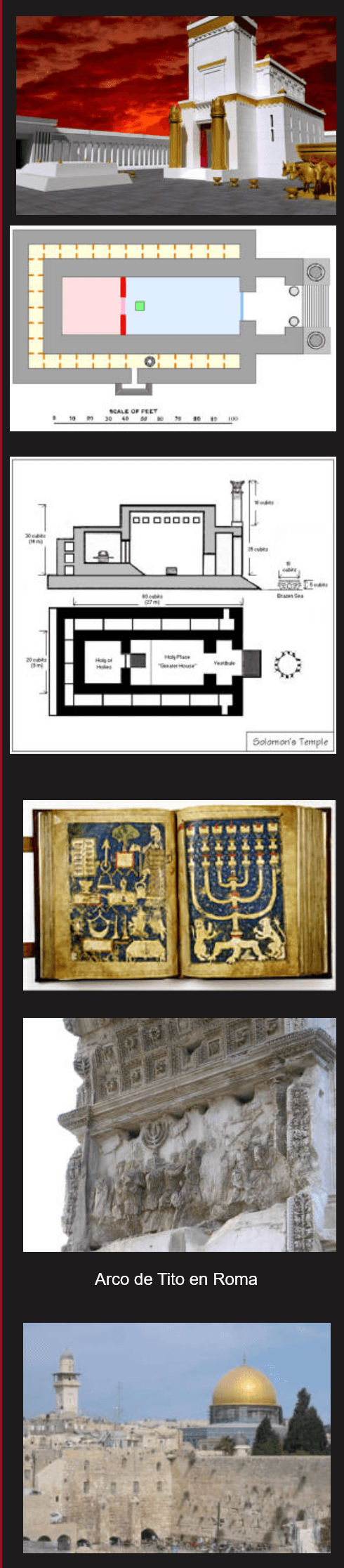
Its main vestige is the Western Wall, also known as Kotel or Western Wall.5 Hebrew eschatology establishes that the Third Temple of Jerusalem will be rebuilt with the advent of the Messiah of Judaism The first temple Computer Reconstruction of Solomon’s Temple (2010). Reconstruction of the enclosures of the Temple of Solomon. From right to left: Hall (white), Saint (light green), Saint of the Saints (rosé). Encyclopaedia Biblica, 1903. Longitudinal section of Solomon's Temple. Glass fragment with the Temple of Solomon, 3rd century.
- Notice the two exempt pillars. Encyclopaedia Biblica, 1903. The First Temple of Jerusalem was built by King Solomon the son of King David around 960 BC. C. and it functioned as the main sanctuary of the Israelites.
- It was located on the esplanade of Mount Moriá, in the city of Jerusalem, where the Western Wall, the Dome of the Rock and the mosque of Al-Aqsa are located today. According to the Bible, the construction of Solomon’s Temple was carried out in the 10th century BC. C., to replace the Tabernacle which, from the Exodus and for centuries, was used as a place of meeting and to worship God.
- The Tabernacle preserved the Ark, which was then brought to Jerusalem by King David and deposited on Mount Moriah, on a platform of approximately 40 by 100 meters. The Temple itself, according to the description of the Bible, was a building oriented on a longitudinal axis in the east-west direction. The building must have had an interior length of approximately 27 meters, 9 meters wide and a height of also 13.5 meters (60×20×30 cubits).
Its dimensions, therefore, were comparable to those of a chapel, but the worship was usually carried out from its outside. On either side of the entrance of the temple were erected two columns, called Jaquín and Boaz. The priests and king entered the Temple through a large golden-plated gate, approximately 10 meters high and 4 meters wide. Behind that door were three enclosures. A lobby was followed by two other enclosures. The first of those enclosures was called Hejal or Holy (i.e., Holy Place or Sanctuary), which was illuminated through high windows.
The width and length of this room was 1:2, which means that the Hejal plant was composed of a double square. The stone forging was covered by a cedar wood floor. The walls and beams of the Hejal forging were covered by Lebanese cedar sheets. The third chamber, called Dvir or Kodesh Ha-Kodashim was the holiest place in Solomon’s Temple. In Latin it is known as Sancta Sactorum and in Spanish as "Saint of the Saints". This last enclosure was at a higher level than the Hejal and could only be accessed by climbing a staircase.
The Dvir was in the form of a cube of approximately 10×10×10 meters (20×20×20 cubits). In its center was the Ark of the Covenant (great chest made of acacia wood, covered with gold plates and with four rings at the corners in which rods were eventually put to transport it; within the Ark were preserved the Tablets of the Law, delivered by God to Moses, and the Tablets in turn carried engraved the Ten Commandments, serving as a connection between God and Israel.6 The inner courtyard of the Temple was surrounded by the inner courtyard of the Temple
In this inner courtyard could enter the pilgrims and the masses of the faithful, but the Shrine of the Temple was only accessible to the priests and the monarch on duty. The construction of the Temple of Jerusalem was the most important event of Solomon’s reign, thanks to which his name has been remembered until 30 centuries after his death. Already in the Bible the Temple captures most of the writings where King Solomon appears.
Its fame has transcended the times and, as an ideal building conceived by God, it is until today an important reference and source of inspiration in projectual and architectural matter.7 After the death of Solomon, the temple suffered desecrations due to foreign invasions and also the introduction of Syrian-Phoenician deities.
However, it was rededicated under its original conditions during the reigns of Hezekiah and Josiah.
Destruction of the First Temple Incise Inscription in the only surviving vestige. The troops of Babylonian king Nebuchadnezzar II destroyed it in 586 BC. C., also, carrying captive a large part of the inhabitants of the Kingdom of Judah to Mesopotamia, which gave rise to the exile and captivity of the Hebrews in Babylon.14
- From the Temple of Solomon only survived a small object of great symbolic value, it was a ivory grenade of the size of a thumb (broken link available in the Internet Archive; see the history and the last version)., highly stylized and with inscriptions in paleohebrean characters: iconographically, the grenades (rimonim in Hebrew) are presented in the cultures of Antiquity as symbols of fertility and hope,15 being already inscribed in paleohebrean characters: iconographically, the pomegranates (rimonim in Hebrew) are presented in the cultures of Antiquity as symbols of fertility and hope,15 being
- The Israel Museum in 2011 removed from the exhibition the grenade, an object certainly of the late Bronze Age, but not so the inscription, which is suspected to be a recent forgery, although there is no evidence of the guilt of the one who sold the foot The Second General Plan Temple of the Temple of Jerusalem. After the return of captivity and with the leadership of Zerubbabel, the necessary arrangements were made to reorganize the desolate Kingdom of Judah and rebuild its Temple, which disappeared by that time seven decades ago.
- The newly arrived group consisted of 42,360 Jewish people, including children, along with their 7,337 servants and 200 musicians (Ezra 2:65). He had completed the long and gloomy return home from the banks of the Euphrates to Jerusalem. The people were encouraged by a strong religious impulse and one of their first concerns was to restore their ancient house of worship, rebuilding the Temple and restoring their rituals. Along with Zerobabel’s invitation, the governor showed a noble gesture by contributing 1,000 gold darics and many other gifts.
- The people also contributed their part to the sacred treasure and did so with great enthusiasm (Ezra 2). First he stood up and dedicated the altar of God at the exact point where his predecessor was. Then the charred debris in what had been the site of the First Temple was cleaned.
- Finally, in the second month of the second year (535 BC. C.), and in the face of the emotion and joy of the public there gathered (Book of Psalm 116-118), the foundations of the Second Temple were laid. This act was important to the Hebrew people, also giving rise to not a few memories (Zechariah 4:10). From the Samaritan offer to the completion of the work The Samaritans made a proposal for collaboration in the work.
But Zerubbabel along with the council of elders declined to the offer as they understood that Judea should build the Temple without external help. As a result, malicious reports were disseminated about the Jews; according to Ezra 4:5, the Samaritans sought to thwart the purpose of building the Temple and sent messengers to Ecbatana and Susa, which caused the reconstruction work to be delayed and eventually suspended. Seven years after this episode, Cyrus the Great, who had allowed and ordered the rebuilding of the Temple, died and was succeeded by his son Cambyses. Then Esmerdis occupied the throne for about seven or eight months.
Finally, Darius I ascended (521 BC. C.) and, in the second year of his reign, the work of reconstruction of the Temple and until its completion were resumed. This was developed from the encouragement, counsel and premonitions of the prophets Haggai and Zechariah. In the spring of 516 a. C., twenty years after the return from captivity in Mesopotamia, the Temple was ready for consecration. According to the (Book of Ezra (6:15), the Temple was completely completed on the third day of the month of Adar, in the sixth year of the reign of Darius I. Herod's Stone Renewal of the Second Temple of Jerusalem with inscription in Hebrew: "Towards the place where the trumpets sound."
The candlestick of the seven arms is among the plunders of the Temple of Jerusalem. Relief of the Arch of Titus, Rome. The Kotel is one of the few architectural vestiges of the Temple of Jerusalem. The great blocks visible in this photograph date back to the Antiquity.18 Wall of the Lamentations, part of the wall of containment of the esplanade of the Revered Temple due to its relationship with the divine presence (Shechinah). Around 19 BC. King Herod the Great began a massive renovation and expansion of the Temple. This was practically demolished and a new one was built in its place.
The new structure is sometimes referred to as the Temple of Herod, but was usually followed by being called the Second Temple. The rituals of sacrifices were taken up in it. The area occupied by the new building occupied an esplanade of 500 meters long by 300 meters wide. On September 25, 2007, archaeologist Yuval Baruch, along with the Israel Antiquities Authority, announced the discovery of one of the quarries that provided Herod with the stones for the Temple.
In this quarry were found coins, pieces of pottery and iron poles, which are dated to 19 BC. C.. Another archaeologist, Ehud Nesher, confirmed that the long outlines of the rocks show that it was a massive public project in which hundreds of slaves probably worked. Characteristics of the Second Temple In the Second Temple were not the Ark of the Covenant, nor its contents comprising the Tablets of the Law and the measure of manna, the Urim and the Thumim, the bronze serpent (destroyed by Hezekiah already in the First Temple) and the rod of Aaron. These sacred objects disappeared after the destruction of Jerusalem by Nebuchadnezzar.
- As in the Tabernacle, the Kodesh Hakodashim (Saint of the Saints) was separated by curtains, there was only one Menorah in the Hechal (Holy), in addition to a table for the loaves of the proposition and an altar of incense; golden vessels were also preserved that belonged to the Temple of Solomon and, although they had been taken to Babylon, they were then returned to the Temple of Jerusalem by Cyrus.
- The Second Temple differed from its predecessor because it presented trees in its courtyard and also possessed an area reserved for the Gentiles. Destruction of the Second Temple In 66 A.D., the Jewish population rebelled against the Roman Empire. Four years later, the 70, the Roman legions under Titus reconquered and then destroyed most of Jerusalem and the Second Temple.
- The arch of Titus, erected in Rome to commemorate the victory of Titus in Judea represents the Roman soldiers taking the Menorah of the Temple. Jerusalem was razed by Emperor Hadrian again in 135. The Temple of Jerusalem is, according to a Christian tradition, the preparatory expression for the new Temple: Christ. She argues that as a dwelling place of God among men, the Jerusalemite Temple prefigures the definitive abode that is embodied in the figure of the Redeemer.
- The basis of this notion has its chief reference in the Gospel: "the verb became flesh, and he put his dwelling among us" (John 1: 14).19 To this is added the prophecy of Jesus about the destruction of the Temple before his disciples, admired before the beauty of the Temple of Herod: When Jesus left the Temple, and he went, his disciples came to him to show him the buildings of the Temple. But He answered and said to them, “Do you see all this? Truly I say to you, there will be no stone left here on stone that is not torn down. Matthew 24:1-2.20
A few years later, in the year 70, the Temple was destroyed by the Romans under the orders of Titus. The only thing that has remained are the remains of the wall of the esplanade, not of the temple itself. However, it has remained since then a "symbol monument" and the most sacred reference site for Judaism.21 Islamic tradition and the Temple Although it is not a mosque in the strict sense of the term,22 the Dome of the Rock is undoubtedly a place of veneration for Muslims.
The Islamic building houses the so-called "Fundational Rock",23 whose significance is of paramount importance to the Muslim creed. The so-called "Fundational Rock" (Hebrew: אבן השתייה, Even Hashetia; Arabic: صخرة, Sakhrah), preserved inside the Dome of the Rock.
The Founding Rock is revered by numerous monotheists as the place where Abraham was to sacrifice his son;24 on this stone formation was located the most sacred enclosure of the Temple of Solomon; and in that same place, centuries after the destruction of the Temple and according to Islamic tradition, the Prophet Muhammad ascended to the heavens, being carried by buraq, a winged horse with a human head that led him there in a "night journey"
It also presents the Founding Rock an important imprint that, according to Islamic tradition, was made by Buraq when ascending to the heavens or, according to another Islamic version, the archangel Gabriel recorded on the Rock the aforementioned imprint.
A hole under the rock, sustains the Muslim tradition, is reminiscent of the turban of Muhammad, who, when rising, rejoining after having prayed, would have hit his head with the stone if it had not been instantly softened. Also considered holy by the Hebrews,26 the place in question is no less revered by the Muslims, who built the Dome of the Rock to preserve that site and what it implies, given that it is extremely significant from a monotheistic point of view.27 Due to its historical and symbolic value, the Dome of the Rock is a constant and dominant image in numerous representations of Islamic culture.
For Muslims even the steps of the Dome of the Rock have an important symbolic value. Eight bleachers dying under an arcade lead from four sides to the top of the Dome of the Rock; Muslims call these arcades "mavazin", the scales.
According to an Islamic legend, on the day of the Last Judgment a horse sow will be laid from the "balances" to the Mount of Olives and all the risen must pass over it: whoever has committed injustices will fall to eternal doom.
